Showing posts with label non-fiction. Show all posts

Sunday, May 28, 2017

Book Review of Gone: A Girl, A Violin, A Life Unstrung by Min Kym


I first heard about Gone by Min Kym on the Blogging for Books website, where I noticed it was garnering five star review after five star review. I had never heard of Min Kym. Lindsey Stirling is my favorite violin soloist, and when it comes to classical solo string performers, I am much more of a cello listener. What could be so compelling about a memoir written by a violin soloist about having her instrument stolen? I remember wondering. And then, I recalled a television interview I'd seen years ago, in which blues guitar player B.B. King spoke emotionally about the experience of having his guitar Lucille stolen. Two things stuck out in my mind about that interview: 1) That King rushed back into a burning building to rescue his guitar, and that when he found out the fire was started because two men had been arguing over a woman named Lucille, he knew what he had to name his beloved instrument, and 2) That an instrument could be so integral to a musician that he would run into a burning building to save it, risking his life without hesitation. So, of course I requested a free review copy of Gone. I had to see if her story was as unique, interesting, and emotional.


Though I understand why each element of the cover design for this book was selected, I don't personally like it. Conversely, I think the author picture included in the back of this book is one of the best I've ever seen, and I think it would've made a wonderful cover for Gone! I find it more aesthetically appealing and memorable than the actual cover. Plus, I'm dying to ask Min Kym how, exactly, she gets her hair to do that. Clearly, if she decides to move on from the world of professional music performance, she could really rock the YouTube hair tutorial videos. Also, seeing this author photo left me with one question: Kym mentions owning and playing several different violins over the course of the memoir. Which one is pictured here?

On the surface, it seems as if Kym has succeeded despite overwhelming struggles. She emigrated from Korea and grew up in London. She was admitted to the renowned Purcell School for musically gifted children, where she excelled and people quickly realized she was a violin prodigy. With a father who was constantly absent due to work that took him abroad for long stretches of time, a sister she never mentions except in the context of playing the piano alongside Kym's violin, and a mother who had the highest expectations of her daughters, but only showed affection through food, possibly creating a toxic atmosphere in which Kym's anorexia thrived, (Strangely, this is only mentioned in the last chapter of the book.) Kym found herself in music.

However, her confidence and her ability to speak up for herself were mostly non-existent. Kym found herself in a relationship with a manipulative man who had previously preyed on other Korean girls, finding them easy targets because the cultural values of submission and self-sacrifice with which they had been indoctrinated made them easy to control. Any time Kym succeeded in recognizing what she wanted and gravitating toward it, or meekly voiced her concerns in an attempt to stand up for what was important to her, he shut it down, ultimately leading to the theft of her beloved Stradivarius violin--a world-class instrument valued at more than many houses but, more importantly, the vessel through which Kym expressed herself emotionally and upon which she built her career professionally.

Gone is the story of Kym's upbringing, her training as a violin prodigy, her discovery of the violin that would define, amplify, and clarify her voice as a person, and as a performer, and the devastating loss of that gorgeous instrument. It differs a bit from a traditional memoir. For one thing, despite the fact that there are assuredly pictures of Kym from her extensive professional performance career, I found it odd and disappointing that they weren't included in the book. Also lacking were photos of the various violins Kym owned and played over the course of her life as a violin soloist, which would've been integral to the story, considering that the importance of her instrument is the essence of the book. And, since Kym goes into great (helpful, and interesting) detail about the parts of a violin, and which ones she tweaked in order to adjust each instrument to work for her as a performer, some diagrams displaying that information would've been useful and informative to the reader. I did appreciate, however, that Kym included generous amounts of information about luthiers, and about today's violin trade. I also enjoyed the parts where Kym would give context about the classical pieces she was working on at that point in the narrative, describing the feeling of the piece, or even going into personal detail about the life of the composer. These anecdotes served to educate me as a reader, but they also underscored for me how personal this music is to Kym, and how intimately she knows it.

However, there is one thing tied into Gone that I haven't seen with a memoir: music. At the very beginning of the book, there's a list of nine tracks which closely relate to the narrative. They are solo pieces recorded by Kym, which are described in the book at various points. In addition to the suggested listening list, those points are marked by a music note and a number in the margins, so readers know when to start each track. But, as wonderful a tie-in as this concept is, the music isn't available to listen for free on YouTube or Kym's website, and the book doesn't come with download codes. Instead, the reader is given instructions on where to purchase the music. So, the publisher expects readers to pay $25.00 for the book, and then pay more (about $15.00 on Amazon for the CD) to listen to the music for the full experience? And, many readers may not know they are supposed to buy music to go with the book beforehand, so they may have brought the book with them somewhere to read where they can't download the music. I feel like the cover price of the book should've been increased, and the book itself should have come with download codes or a CD of the music, this requiring only one purchase for the full experience. This aspect of Gone was poorly designed.

Overall, Min Kym's writing was refreshingly honest, self-aware, and beautiful in a simple, poetic way. There were some grammatical errors I feel her editor should've caught, but it's obvious that Kym knows how to tell a story. Also, Kym didn't shy away from aspects of her life that didn't put her in the best light. Gone isn't the story of a girl trying come off as perfect, though it so easily could've been. Kym writes vulnerably, and the result is powerful, endearing, and sad. It shows how integral an instrument can be to a musician, and how crucial it is for women to be taught as girls that what they say and how they feel matters, and that they shouldn't suffer the company of anyone who disagrees.

Highly recommended.

As a little sidenote, I just noticed this is my 100th review for Blogging For Books. This is a great program, and I really enjoy participating in it! I never would've discovered many books I've truly loved without BFB, Gone being one of them. 

Friday, May 26, 2017

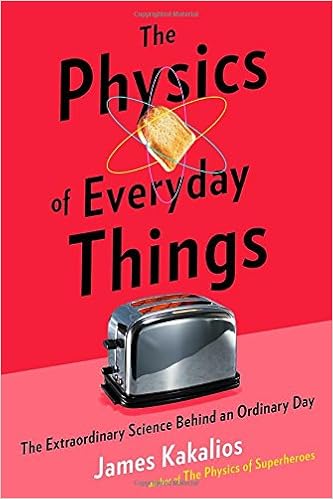
Book Review of The Physics Of Everyday Things by James Kakalios


I like understanding how scientific concepts apply to common things in everyday life. For example, no science lesson sticks out in my mind more than the time my AP Bio teacher gave an in-depth explanation of how a hair dryer works. I don't know why, but I've always found that sort of thing fascinating. So, it was without hesitation that I requested a free review copy of The Physics of Everyday Things: The Extraordinary Science Behind an Ordinary Day by James Kakalios. And I thought I was in for a real treat--an entire book about what I'd loved so much from that class session. From the cover design, I surmised that the book was fun and pithy, possibly full of wordplay, and definitely jam-packed with full-color illustrations and diagrams to help readers understand the concepts being explained.

Nope. That couldn't be further from the case. The Physics of Everyday Things took a reader who was excited to learn about science and turned that opportunity into a snooze. There were no color illustrations of any sort within the book. The only diagrams were boring and very minimalist. Kakalios' idea of an "ordinary day" is somewhat asinine, except for a high-powered employee of a Fortune 500 company--I'm pretty sure that isn't going to be the demographic for this book. The pages within are mostly wall-to-wall print, thick with long scientific terms. And Kakalios does little to temper this dry material and information-dense text (most of his efforts therein come in the form of awkwardly using second person POV, which completely does not work in this application).

All in all, I truly have no idea who would want to read this book. Readers who would willingly slog through all of the scientific terms with a complete lack of visual interest would be better served by more advanced book, or an actual textbook, and would probably be annoyed with the second person usage and tired scenarios used to present the information (You Go To The Doctor, You Go To The Airport, You Take A Flight), which come across as ill-contrived as a pizza delivery at the beginning of a bad porn film. And readers who might feel buried underneath all of the scientific terms and hungry for the brightly-colored pictures and helpful diagrams the cover design promised would probably just give up and stop reading well before the end of Chapter One. Not recommended.

Wednesday, May 24, 2017

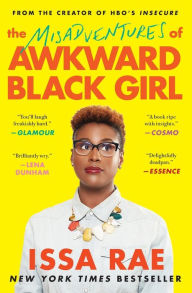
Book Review of The Misadventures Of Awkward Black Girl by Issa Rae


The Misadventures Of Awkward Black Girl by Issa Rae is one of those books I've been wanting to read since it came out last year. So, when I opened my Glommable Glombox here and discovered a shiny new copy, I was stoked! I got even more excited when I saw it had been blurbed by Mindy Kaling, as I've read and enjoyed both of her memoirs--link to my review of Why Not Me? here. I found the cover of Misadventures instantly charming. Everything from Rae's awkward facial expression to her quirky ensemble was endearing to me. The bright, bold colors gave me a hint about the bright, bold personality I hoped would emanate from the memoir.

As I read more of Misadventures, I realized it was like a mashup of Kaling's memoirs (WOC whose body type doesn't align with societal standards struggles to fit in, but is considered a dork by her peers, and uses humor to gloss over here glaring social inadequacies), and Born A Crime by Trevor Noah (POC with one parent born in Africa, who has spent years living there, and who looks at Black culture part as a participant and part as an amateur Sociologist, through the veil of humor), of which my review is here. Since those are all ingredients I find supremely compelling within a memoir, and I loved Kaling's and Noah's books, I was left perplexed that I didn't enjoy Rae's own take on social awkwardness, Black identity, extended family living in Africa, and body image struggles. After all, it was well-written, equally balanced in apt observations and shameless self deprecation, and full of charming 90s pop culture references.

Rae, herself, is an empathetic narrator. I found myself rooting for her from page one. But, ultimately, I think my sense of humor just isn't compatible with her humor writing style. And, even though I didn't enjoy reading this half as much as I thought I would, I came away from the experience with a newfound appreciation for the unique and timely public persona Issa Rae has crafted. That said, if you're a fan of hers, you'll want to give The Misadventures Of Awkward Black Girl a try. 

Tuesday, May 23, 2017

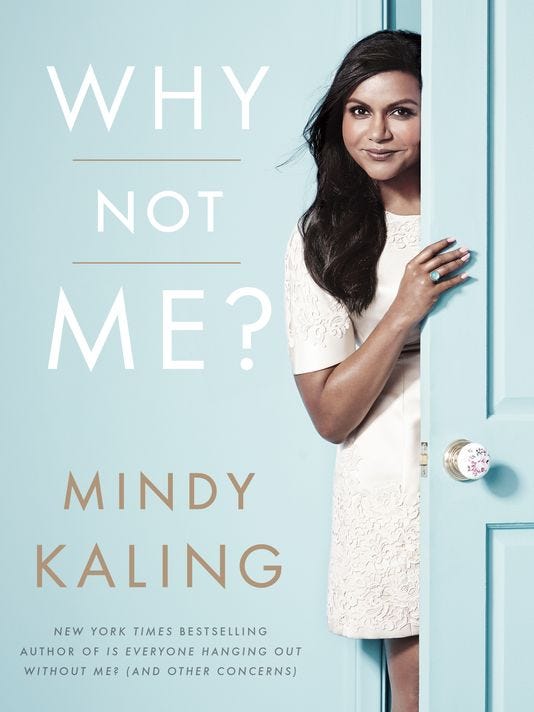
Book Review of Why Not Me? by Mindy Kaling

Since I enjoyed Mindy Kaling's first book, Is Everyone Hanging Out Without Me? (And Other Concerns), so much, I jumped at the chance to get a free copy of her second book, Why Not Me?, for review from Blogging For Books. It did not disappoint.


I love that Kaling's writing is witty and approachable. I love that her take on women's issues and her attitude about Hollywood are both totally real and grounded. I love that every facet of this book, from the back cover design to the endpaper graphics, from the photos to the author bio is completely in line with Kaling's identity and absurdly hilarious.

My favorite part of Why Not Me? was easily the section with the chapter about beauty advice here Kaling talked about hair. She uncovered the--let's be honest, no longer surprising--truth that pretty much everyone on TV has fake hair. The picture of "her" before all of the Hollywood styling (a photo of Gollum from LOTR made me laugh out loud... not just because I have a friend who has hair thinning due to some medical problems who recently described herself as having had "Gollum hair," but also because I admired the ladyballs (yeah, just like in Easy A) to admit that nobody looks like they do on screen in real life, and to encourage the women reading her book not to compare themselves and their appearances to a standard of beauty she herself can't even attain without a whole team of stylists and a barrage of beauty products.

If you like Kaling herself and find her funny, enjoy her TV show, or devoured her first book, grab this one for sure!

Thursday, May 18, 2017

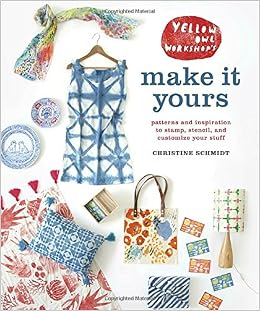
Book Review of Yellow Owl Workshop's Make It Yours by Christine Schmidt

I requested a free copy of Yellow Owl Workshop's Make It Yours: patterns and inspiration to stamp, stencil, and customize your stuff by Christine Schmidt from Blogging For Books for the purposes of review because I've been wanting to get back into crafts lately. This type of creativity isn't something I do all the time, but every once in a while, I get a yen to put stamps to paper, dye fabric in intricate patterns, or feel a brush glide over clay beneath my hand. I especially enjoy saving money on gifts or decorated items by making them myself. However, when the book arrived, I must admit that I was a little disappointed in the cover design. Though I could see the possibilities in each project showcased on the cover, how much the finished products contrasted sharply with my personal aesthetic made me wonder if Make It Yours was really going to enable me to make anything mine...  or if I'd just be churning out craft projects I didn't love and wouldn't want to use or give away.


However, the more of this book I read, the more I realized that most of these projects are highly customizable, and simply by selecting colors or creating patterns that fit into my own personal tastes, I'd still be able to follow the steps included and make the projects in Make It Yours truly mine. Here are some of the projects I've added to my to-do list from this book:


  • The Laundry Bag (This seems like an easy, low-budget project to decorate a personalized laundry bag that would be more fun than work. I'm going to file this one away under, "Ideas for high school graduation gifts," and bust it out the next time I need to come up with a present for a college-bound grad.)

  • The Custom Monogram (I maintain relationships with several penpals, and I'm a bit of a stationery fiend, so the idea of creating my own custom stationery is appealing. In the past, I've done several things with pre-made rubber stamps, but creating my own monogram stamp--and perhaps monogram stamps for others, to make gifts--is very appealing to me, especially because this project is simple and easy, and will enable me to use plain paper and envelopes I already have on hand, keeping my costs low. However, if you don't have paper and envelopes, and you don't want to buy them, there are even patterns included along with directions for making your own.)
  • The Logo Stamp (Similarly, this project also involves creating your own stamp, although this one uses a Carve-a-Stamp block or rubber block, so it is a significantly more advanced. I did this one time in a middle school art class and loved it, so I'm eager to try again with the new application of a logo... perhaps for this blog? I appreciate that Schmidt included not just the step-by-step instructions for actually making the stamp itself, but also lots of tips, tricks, and things to keep in mind when designing your own logo.)
  • The Art Deco Dresser (This one is more of a long-term goal, and is the big kahuna of my list. We currently have a plain dresser in need of a new paint job that I use to hold most of my medical supplies, and this advanced project involving gold leafing with patterns included in the back of the book in one of my favorite styles, Art Deco, will be just the thing to make it look new again.)


The reason I wanted to review Make It Yours specifically is because I heard that Yellow Owl Workshops was infamous for taking things to the next level: by Schmidt's lead, you don't just stamp--you create your own stamps, you don't just tie-dye--you board clamp to create straight lines on the fabric, you don't just paint pottery--you DIY Delftware-style. This is a benefit and a drawback of the book, depending on what your level of ability, experience, and budget might be. If you've done lots of crafts at home and you're ready for something more advanced, if you aren't intimidated by projects that have lots of steps, and if your budget (or your craft supply stockpile) can withstand several projects requiring 10-25 tools or supplies necessary to complete them, but you're looking for something new and different to kick things up a notch, this is exactly the right book for you.

But, if you're a beginner at crafts who doesn't have many of the basic skills down and has a small budget (or lacks a stockpile of supplies, as many beginners do), then you may ultimately find Make It Yours frustrating and intimidating. While there are several projects in the book that only require a few supplies, and don't employ advanced crafting skills, I doubt somebody who purchased Make It Yours with the intention of only doing those projects would feel it was worth the investment. My guess is that they'd probably just feel frustrated at their lack of experience or resources, and regret not having chosen a book that was more suited to their needs and goals.

I love the large size of this book, and the fact that it is paperback to keep the cost down, but seems durable. I really don't understand why the publisher would have made such a book's binding so it doesn't lay flat in an open position. I mean... you expect me to spend hours following your steps through a craft that takes potentially dozens of actions and tools or supplies on my part, and you also expect me to fight to keep the book open whilst I do it!? I also appreciate that patterns and templates for many of the projects are actually included in the back. I don't like that not all of the projects in the book have clear lists of supplies needed or difficulty ratings, and I don't understand why something that seems so crucial to the chosen format wasn't maintained throughout the book. The big, colorful illustrations add lots of visual interest, and also serve as explanations where the step-by-step instructions might still leave questions as to what the finished product should resemble. I like that Schmidt seems to have really thought through what a home crafter's experience would be when working through the steps of each project, and she included as much information as possible to help with any obstacles her readers might encounter without heaping on so many details that it would become overwhelming. I don't like how the book is organized, more by how the patterns look than what their purpose is. I'd prefer to be able to turn to a section on textile crafts, one on papercrafts, one on gifts, one on things that could be used for a small/home-based business, etc.

Ultimately, I recommend Yellow Owl Workshop's Make It Yours only for serious, experienced crafters ready for more advanced projects that require lots of time, skills, and supplies,

Thursday, May 11, 2017

Glommable Glombox #1: A Review and Unboxing

I'm lucky enough to have won a Glombox from Glommable at Glommable.com, and it just arrived, so I thought I'd do an unboxing post. If you aren't familiar with the website (or the new box), they're both focused on the intersection of books and pop culture, with a mix of high-brow and low-brow, and all that's in between. The box felt like it was curated by Rory Gilmore and Mindy Lahiri. The card enclosed inside the top of the box explained both the website and the rationale for its contents pretty well, although it didn't adequately explain that this isn't actually a subscription box, but is instead a sweepstakes, of which there were 10 winners, but I dug around a little bit for that info. You can see the card nestled inside the box atop the turquoise tissue paper that concealed all of the other contents. I particularly love the humor and snark with which the card was written.

That's a pretty strange decision, and I wonder why Glommable won't be offering a subscription option for these, since I predict there will be a demand for them. Each of the prize boxes' contents was valued at $100 USD. Fortunately for you readers, though, most of these items are available for purchase at your favorite bookstore, so let's get to unpacking!

Once I opened the tissue paper, the first fun little trinket in the box was a card explaining Mabel, Glommable's mascot. Attached was an enamel pin featuring her charmingly strange little likeness, pictured below. You can see how all of the Glombox's contents are nestled atop colorful little blue paper shreds, which would've been charming and fun... except that they were a dark sky blue, and the tissue paper was a teal/turquoise color, so they actually clashed with each other. Also, I think Mabel is cute, but since I have absolutely no use for enamel pins whatsoever, I have no idea what I'm going to do with her. ...suggestions?


Once I moved the top layer of paper shreds aside, I discovered this glossy sheet of silly photobooth-style photos of Anna Kendrick wearing the outfit she wore on the cover of her recently published memoir, Scrappy Little Nobody. Stuck through the one square not featuring a photo of Kendrick is another enamel pin, this one decorated with the words 'scrappy little nobody'. Though I've truly enjoyed some of Kendrick's performances, I have actually already read Scrappy Little Nobody, and I can't say I cared for it much. In fact, I didn't post a review because I disliked it too much to finish the book. That's okay, though. Sometimes, a person who is a solid stage performer has talent or charisma that doesn't translate to the page, and I felt that was the case with Kendrick.


So, of course, the next item was a hardback copy of Scrappy Little Nobody by Anna Kendrick.


But, this one is autographed. I'm sure that, if I were a bigger fan of the book, or of Kendrick in general, there would've been some *squee*ing happening at this point.


Underneath that, There was a copy of Hyperbole and a Half by Allie Brosh. I love that book! In fact, I love it so much that I already own it.... I've followed the blog forever, and I really enjoy Allie Brosh's honesty about mental illness--the way she writes about her own struggles with Anxiety and Depression is both hilarious and somehow helpful to readers who might be dealing with similar issues. Also, I love that her lack of what traditional art scholars may call "talent" with drawing (aka, the people she draws look like the people I'm able to draw), doesn't hold her back from telling completely entertaining stories about her life. I wish, instead of including two extra items (the enamel pin and the photos) themed on Scrappy Little Nobody, Glommable had chosen to add some Hyperbole and a Half swag... as long as it wasn't yet another enamel pin!


However, I was thrilled to see that the next item was a copy of The Misadventures of Awkward Black Girl by Issa Rae, because this is actually on my TBR list! Also, as a diverse book blogger, I'm excited because it means I've got another #ownvoices title by a diverse author on my shelf. Expect a review sometime soon. (I had to put one of the other books back inside the box underneath it because those pesky little paper shreds kept obscuring the cover when I tried to take a picture and the book was sinking into them like a very small child in the ball pit at Chuck E. Cheese.)


The next title I unearthed was You're Never Weird On The Internet (almost) by Felicia Day. I don't have much of a frame of reference for this book--actually, it was the only item in the box that I wasn't familiar with in one way or another)--so I had a pretty neutral reaction when I pulled it out. A memoir with a bonus chapter included and a foreward by Joss Whedon piqued my interest, though, so this one has been added to my TBR to read and review. Have any of you guys read it? What are your thoughts?


Just when I thought I'd reached the bottom of the Glombox, I moved all of the blue paper shreds of doom (TM) aside to discover that there was one last surprise... a Pusheen coloring book!


This was a nice addition to the box because it was the only book-like thing included that had the sole purpose of frivolity, with no serious element at all. But, I found myself wishing that the Glombox curators had included a little Pusheen goody, like maybe a pen, or a sheet of stickers instead of the Kendrick photos or one of those tiresome enamel pins that also have no actual use.


Here's my favorite page from the coloring book:


(I actually saw some memo pads with this design on them on an endcap in the stationery section in B&N, but I couldn't afford them, so I had to drag myself away.) That makes me extra pumped that this coloring book, and this particular design, was included in the box. I'm thinking of framing this page and hanging it in my closet for a little inspiration when I'm getting dressed and I have trouble deciding how fancy to be. Now, here's a question for you: I have a Doctor's appointment tomorrow. Do you guys think the dress code is merely kind of fancy, or actually super fancy? I mean, do I need to be tracking down a unicorn before I show up there tomorrow?

Ultimately, I'm super grateful to have won a Glombox, and it definitely motivated me to check out Glommable.com, which is a website I'd heard about a time or two in passing previously, but wasn't on my radar much before. I have no idea why they aren't offering this as a subscription, unless the sweepstakes is merely a test run before they start a subscription service (which could be a smart way to do things). 

Overall, I enjoyed the contents of the box. They struck a good balance between high culture and low culture/serious and humorous. I would've enjoyed a more cohesive theme, and I would've liked if they stayed away from those seemingly purposeless enamel pins entirely. As someone who loves to send care packages, I was particularly taken with the size and shape of the box (it was a very attractive square-topped box with a lid that tucked into the front and folded upward from a hinged back). I felt the presentation could've been a little better--maybe fancier?--by simply attaching the explanation card to the inside of the box lid, choosing tissue paper and paper shred packing materials that matched or coordinated with each other, and maybe having one other decorative element within the packaging itself. I also would've liked to see a little more diversity amongst the authors whose works were included within the box. Since that is such a selling point, and a hot-button issue in both publishing and pop culture today, it surprises me that the Glommable curators would be so tone-deaf on this point. Still, this is their first crack at the whole Glombox thing, and there's always the next box!

Wednesday, April 26, 2017

Book Review of The Illustrated Pirkei Avot: A Graphic Novel of Jewish Ethics by Jessica Tamar Deutsch

Image result for the illustrated pirkei avot jessica tamar deutschI don't think I could've been any more eager to review a book than when I found out someone had turned the Pirkei Avot into a graphic novel. I love graphic novels, and one of my favorite things to do as a Jew is study Jewish ethics, so I thought this would be a beautiful intersection of two of my strongest interests. I was a little less than thrilled when I saw that the illustration style was a bit hippie for my taste, but I figured it fit in with the "do unto your neighbor" message of the Pirkei Avot's teachings, so, bring on the Hamsas! That said, when the free copy I requested for the purposes of writing this review arrived, I couldn't have been more thrilled with the beautiful colors and metallic foil on the cover. Isn't it gorgeous? I couldn't wait to see how those amazing hues would look splayed across the pages of the text illustrating the Pirkei Avot!

Immediately, I encountered a huge disappointment: those eye-catching colors from the cover don't carry over onto the pages of the graphic novel, which are printed solely in black and white. In fact, this book is marketed as if it can also be a coloring book, as if that's a benefit, and not simply the result of a small press not making the investment to include pretty color printing to add visual interest to the body of work. Though I can see some people enjoying a coloring project such as this, I can also see that many readers will be extremely disappointed by the lack of color throughout the text, especially because it is called a graphic novel. (If it were called a coloring book, that would be a different story entirely.) Also, when charging $25 plus shipping for such a volume, I, and most other readers of graphic novels, tend to expect at least some color illustrations, especially when the book has only about 120 illustrated pages to begin with. And it was clearly not designed to be a coloring book: the pages are not perforated, the book does not lay flat, the thick, dark, black ink smudges when art markers are used to color in the white space, and the paper fibers shred when even the lightest pressure is applied from said art markers. So, $25 plus shipping is very expensive for a sub-standard coloring experience OR a sub-standard graphic novel reading experience.

However, I was still totally into the concept of the material within the book, and ready to get started refreshing my memory about some of the core tenets of Jewish ethics. After all, who can't use a refresher course? I was eager to see how Jessica Tamar Deutsch had managed to structure her book in such a way as to string together so many small nuggets of advice, wisdom, and teachings into a cohesive enough whole to make a graphic novel, instead of the format of the actual Pirkei Avot, which can be frustratingly disconnected and jolting as it moves from the teachings of one sage or Rabbi to the next, and topic to topic without transitions. Surely, someone from such an artistic background who was so free-thinking and creative and felt such a personal connection with the material had found a new way in and been able to break the teachings down into themed sections, or add a narrator to the text to guide the reader through it and parse the famous quotations for applicable meaning. Nope.

Deutsch's strength is her illustrations, which serve as the backbone of the work. If you love the style of her artwork, you'll treasure this book. If you find it grating on page 15, you'll be ready to tear your hair out by page 70, which features an elderly biker dude in a skull-decorated helmet growling angrily down the road on his hog past a cartoonized cactus. I just found it all distracting and annoying, instead of enlightening and enriching. I was hoping the illustrations would help me parse some of the more difficult-to-understand passages, but instead they were too hokey and trippy for me to take seriously, even when they were accompanying very serious teachings and text. For students of any age who find the original Pirkei Avot dry and difficult to engage with, and who enjoy this style of art, The Illustrated Pirkei Avot might provide a solution to that problem. The text is large, and boiled down to only the most sparse of necessary details.

My biggest complaint about this book is that Deutsch simply got some basic things wrong. I don't know if she (or her editor) didn't properly check the details, or cared more about the art than the text (which would be unfortunate, since it is being marketed as a religious teaching tool), but some of the quotations are incomplete, others are interpreted in bizarre ways, and still others are blatantly incorrect. Aside from my personal taste with regard to the artwork (which, I fully acknowledge is just that--my taste--and may not be shared by everyone), I cannot recommend this book for any purpose because it contains inaccurate teachings/translations/quotations.

Monday, April 24, 2017

Book Review of Drama High: The Incredible Story of a Brilliant Teacher, a Struggling Town, and the Magic of Theater by Michael Sokolove


When I was about to enter high school, I read a nonfiction book about high school called South of Heaven: Welcome to High School at the End of the 20th Century. It was written by education reporter Thomas French, who followed five high schoolers around for a year and chronicled their lives. I remember that it featured students who fit stereotypes that could've been ripped from The Breakfast Club or The Perfect Score, in an out-of-touch adult's attempt to portray all facets of the high school experience. It was terrifying. It was moving. It was also accurate. Drama High by Michael Sokolove could be described as a mashup of that, plus Glee. But, it is also much more than that, because it also functions as a biography of Lou Volpe, the man who created the most groundbreaking and instrumental high school theater program in the US. So, when I heard about it (better late than never, right?), I had to check it out from the library.

There's always something compelling about a group of scrappy kids with the odds against them excelling at something nobody expects them to be able to do with any sort of skill. This particular story is the something-out-of-nothing narrative every kid whose school calendar has a marker-scribbled countdown to the Tony awards scrawled over the top of school assignments and choir concert dates will eat up with a fork and knife. When the miniseries based upon this book is released (slated for later this year), I wouldn't be surprised if hundreds of Broadway hopefuls spend the time between dance classes and monologue rehearsals trying to talk their parents into moving to Levittown, Pennsylvania--the blighted blue-collar community out of whose concrete this rose has emerged.

But focusing on the kids, or the precocious theater program which shines like a beacon from the otherwise mostly darkened landscape of Harry S Truman High School, is like admiring the tree trunk and branches and leaves without acknowledging its roots. The root of this landmark drama program is Lou Volpe, a man who spent four decades building it, shepherding students from unlikely places toward his own personal love of theater, and giving them a ticket out to somewhere bigger and full of more opportunities than two part time jobs and a lifetime of near-poverty in Levittown. He is perceptive. He is endlessly interesting. He is empathetic. He is gay, which is considered an open secret within the Truman community. And, until fairly recently (all things considered), he was married. He has a son.

Sokolove made interesting choices when it came time to piece Drama High together--some were brilliant, and others were ineffectual. I appreciated that Sokolove allowed readers to view Volpe through the eyes of many different people: former and current students, parents, teachers, administrators, his family, and members of the community. When dealing with a subject such as Lou Volpe, I suspect there is always myth to separate from the man, and having as many sources as possible seems like the best way to enable readers in that endeavor. But, just when it felt like the narrative of the story was developing in one direction, it would take a sharp turn in another for no apparent reason. Some of the sections felt like they were included in the book out of order, and others felt as if they didn't belong at all. The biggest assets Sokolove brought to the table were perceptive descriptions of his hometown (and Alma Mater), and the nice balance he struck between impartial observer and fan who couldn't help but root for the town, the school, and the theater program to succeed. Because of this, readers will be rooting for all three, and also Volpe and his students, which makes Drama High so much more than a nonfiction book about education.

However, some of Sokolove's research was inaccurate (asserting that the IB program is equivalent to the AP program, for example, when one is only recognized within the US and the other is worldwide, and IB is widely known to feature much more rigorous coursework). And other assertions felt like they were off-base simply because he was a bit out-of-touch, due to too many years lapsing between his graduation from high school and the publication of Drama High. I wondered if some of his interviewees (especially current students) wouldn't have been more candid with a writer closer to their own age.

Drama High can be read on an entirely different level by a teacher: this is how to formulate a meaningful connection with your students. This is how to reach out to kids with home lives that are beyond troubled and sacrifice of yourself to provide them with the security they need to take the important risks, Volpe's actions seem to say. How to fight red tape. How to gain opportunities and resources for your students. How to make allies. How to enable kids to achieve greatness.

Ultimately, there's much to love about Drama High. If you have an avid interest in theater, learning about the test pilot program for high school productions will be a real treat. If you fondly recall your own days auditioning for the school play and going out for milkshakes after rehearsal, Drama High might provide a nice trip down memory lane. If you're a teacher looking to read about a highly effective educator, this is a must-read. And, if you're planning to watch the TV miniseries, well, I always say you should read the book first.

Tuesday, April 11, 2017

Book Review of Coming Clean: A Memoir by Kimberly Rae Miller

After reading Gwendolyn Knapp's supremely unsatisfying hoarding-related memoir (check out yesterday's review), I wanted to know if there were any books out there that tackled the same topic with more aplomb, so I put a copy of Coming Clean: A Memoir by Kimberly Rae Miller on hold at the library. Contrary to what the super disappointing cover design led me to believe (and, ugh, when I saw it, I was not expecting much), it was a night-and-day difference!

As I mentioned in the previous review of a memoir dealing with hoarding, I'm the kid of hoarders. My Dad is deceased, and my Mom is currently working to reform her hoarding ways, so, just as I was supremely disappointed in the carelessness and superficiality dripping from After A While You Just Get Used To It, I related deeply to the seriousness, frustration, and pain emanating from Coming Clean. Miller truly bared herself and her painful childhood experiences, growing up the daughter of hoarders in a time before there was a TV show, a cultural touchstone, a functional psychological diagnosis, or even a word for such behavior. In Coming Clean, Miller didn't attempt to offer up her parents' foibles and obvious psychological problems and their resultant hoarding and quirks for laughs, but instead gave a realistically detailed account of what it was like to grow up marooned on an island of filth. For those who have been there, Miller is clearly a comrade-in-arms. For those who haven't, just know that she provided an accurate depiction: that really is what it's like.

Coming Clean deals with much heavier issues than being unable to recycle some old newspapers. Miller's parents couldn't have been more loving, but with her dad's mental illness and her mom's severe back problems, they were inept at providing a clean, safe environment for their beloved daughter, or their pets. Even after growing up and physically escaping her parents' prison of stuff (one of Miller's main reasons for wanting to go away to college), she suffered anxiety, nightmares, and other symptoms of PTSD from her experiences living in their mess, as well as physical symptoms (infections, asthma, and other breathing problems) brought on by the clutter and germs. Miller also eloquently discusses the isolation she and her parents experienced because of their hoarding--from society, their family and friends, and from each other. Ultimately, Coming Clean is the story of a daughter who is at her wit's end with her parents' hoarding, but who loves them despite the fact that they can't let go of their useless collections of junk. It is a sad story. It is a true story. It is a story very much worth reading. Highly recommended.

Monday, April 10, 2017

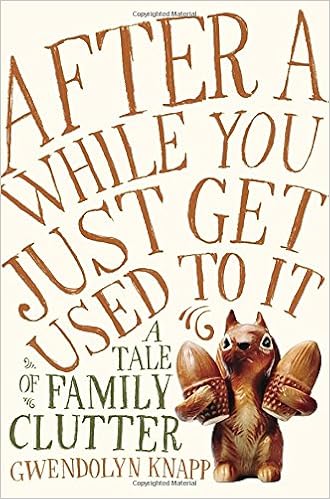
Book Review of After A While You Just Get Used To It: A Tale of Family Clutter by Gwendolyn Knapp


I entered a contest for a free copy of this book because I read a blurb about it and saw the cover and I knew I had to read it! Why? Well, my Mom is in the process of becoming a reformed hoarder... and she considers squirrels her mortal enemies. So, this is one of those books I wanted to read and then share with her. I was thrilled when it arrived in the mail, as I assumed I'd enjoy it immensely and be excited to see her reaction. I mean, the cover is just hilarious even by itself, right? I love the way the squirrel could both symbolize a hoarder (hoarding nuts), but the squirrel figurine could also be clutter in and of itself, and it is fun and quirky. Genius! ...if only the book followed suit. In all fairness to this book, maybe Gwendolyn Knapp's sense of humor just doesn't match up with my own, because I've seen a couple of different reviews compare it to David Sedaris or Jenny Lawson, both authors of books I thought I'd like, books I wanted to like, but books I actually loathed. So, if you enjoy those other authors and their particular off-beat brand of humor, maybe this book is the nut you should be storing for winter. Otherwise, not so much.The main problem I had with this book is that it lacked balance; I was hoping that, in addition to narrating hilarious scenes of the clutter acting as a hostile environment or even personified as an antagonist in and of itself, Knapp would also analyze the clutter. Did her family's collection of useless junk signify mental confusion? ...a worthless (and somewhat rusty) security blanket? ...the desire for material wealth? A book like this would have to walk the fine line between theatre of the absurd-style humor and poignant, evocative emotion. On those counts, it completely failed. Instead, Knapp seemed to be under the mistaken impression that barely connected reminiscences whose only shared commonality was clutter as their backdrop somehow gelled into a larger plot or character arc. They did not.

Also, because Knapp didn't portray herself as an empathetic protagonist with a clearly defined mission on the brain, I couldn't root for her. Readers will likely be left with no sense of who she is, or ability to tell what it is she wants. How can I be on her side if I don't even know where it is when buried under all of the superfluous stuff? As a reader, I feel as though Knapp invited me over to her family's overstuffed home, beckoned me to follow her thorough the labyrinth of a living room, maze of a master bedroom and dump of a den only to present me with the back door, fling it open, shrug, and say, "Bye! Thanks for coming over!" waving as the dented screen door slams behind me, the utterly bewildered reader.

What is the point of this book? I couldn't tell. I wish I hadn't wasted my time reading it, and I'm surely not going to waste my Mom's by giving it to her. Well, that, and I wouldn't want her to add it to the top of yet another growing mountain of pointless possessions because, contrary to what Knapp's title may assert, I haven't yet gotten used to it, and her assertion that such a thing is possible leads me to believe that her family's "hoarding" isn't the real deal, after all.

Sunday, April 9, 2017

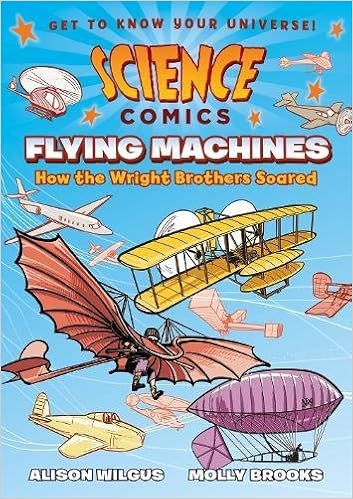
Book Review of Science Comics: Flying Machines: How the Wright Brothers Soared by Alison Wilgus and Molly Brooks

The latest installment of Science Comics, a series of non-fiction graphic novels catering to an MG reading level and audience, is Flying Machines: How the Wright Brothers Soared by Alison Wilgus and Molly Brooks. If you aren't familiar with the Science Comic series from :01, each volume features a full, information-packed narrative explanation of the titular concept, which has been reviewed by an expert in the field. After the guided tour, which reminded me of a more in-depth lesson from Miss Frizzle herself (win!), and is tailored to readers ages nine and up, the book also includes a section of notes and a bibliography for readers whose interest hasn't been quelled by just this one volume and who would like to learn more about the topic at hand.

In this volume, author Alison Wilgus introduces readers to a historical figure they may never have heard of: Orville and Wilbur Wright's younger sister Katharine. Just like many little siblings, Katharine took a great interest in the exciting project her big brothers were involved with, and was their biggest champion along the way. She was an interesting choice to serve as a narrator for the story, because many readers of Flying Machines have no doubt either been the little sibling who watched from the sidelines, or had such a brother or sister. Also, it is surprising to note that she was so integral to the Wright brothers' development of their flying machine, but that, without having read this book, I never would've heard of her. Katharine really humanized the narrative, adding in colorful commentary and emotion, and keeping Flying Machines from being simply a list of historical dates and facts. It was an effective storytelling choice, for sure!  One of my favorite parts of the book was the mini biography of Katharine Wright included near the end.

I also appreciated that Flying Machines incorporated a depiction of the race to invent a flying machine. Many kids (including me) probably grew up with the belief that the Wright brothers were the only ones working on such an invention, so I think it is important to note that, actually, several other parties were toying with similar ideas at the time. It was fun to see how they fed off of each other's concepts, and how one person's obstacles might lead to another inventor's breakthrough.

Molly Brooks' illustrations really won the day. Her drawings of planes (and other mechanisms) in flight really captured the motion of each one, so they came alive from the page. Reading Flying Machines was kind of like watching a Miyazaki film, due to her lively and imaginative drawings. I also loved the colors she selected for the settings and clothing of her characters--the warm brown and gold tones and cool blues really added to the story and set the time period in my mind. Brooks' depictions of Orville and Wilbur made them stand out in my imagination, whereas when I'd read about them previously, the brothers were somewhat interchangeable. Her characterization of Katharine was endearing and kept me interested even in parts of the story where the narrative lagged where it was held down a bit by lots of technical detail.

Coming out on May 23rd, teachers, parents, and aviation fans alike will be thrilled by this detailed, educational graphic novel history of the origins of heavier-than-air flying machines. You can preorder it now. If that isn't enough, previous titles in the series cover coral reefs, dinosaurs, volcanoes, and bats. (I really wish I'd gotten my hands on the one about dinosaurs, myself, as anyone who knows me knows my love of dinos is deep and profound!) I can really see these books being useful for science teachers or homeschool parents to build lesson plans (especially with the bibliography, glossary, and notes inclusions at the end of the texts), or as wonderful gifts for curious scientifically-minded young readers to learn independently, because of the lively dialogue and colorful illustrations. But, even as someone who isn't particularly interested in flight, and who read the book as an adult, the strong partnership of Wilgus' writing and Brooks' illustrations kept me hooked until the very last page. Highly recommended!

Wednesday, April 5, 2017

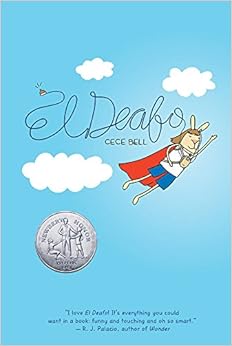
Book Review of El Deafo by Cece Bell

I wanted to read (and review) El Deafo by Cece Bell for three reasons. One is that, thanks to a crappy immune system, I've had over a hundred ear infections (and tubes three times) in my life, and I'm lucky to still be able to hear, but I never want to take that for granted. Two is that, of course, it fits right in with my mission as a Diverse Book Blogger. (Click the link in the right sidebar for more information.) And three is that sign language and Deaf culture are very important to my husband, a teacher who has some Deaf and hard-of-hearing students, has volunteered at a Deaf camp, and is trying to start an ASL club at his school currently. So, when he mentioned wanting to read this book, I figured I'd join him. His book pick was solid, and I was far from disappointed. I just love the cover. The way the characters are drawn in this book really reminds me of the Arthur books, which I really enjoyed as a kid.

El Deafo is Cece Bell's graphic novel autobiography of becoming deaf and navigating childhood afterward. A cartoonized Cece (sometimes the caped superhero version she imagines of herself, the titular El Deafo) deals with friendship drama, classroom challenges, hearing aid malfunctions, unnerving doctor's appointments, scary sleepovers, and feelings about her sudden hearing loss. If there is one basic throughline of the story, it is Cece learning to live with her deafness and figuring out who her real allies are during a difficult time of change and growth.

El Deafo could be useful to hearing kids who want to understand what Deaf or hard-of-hearing kids are going through. Bell takes the time to explain things step-by-step, such as how to speak if someone is trying to read your lips, or how to be considerate of a Deaf or hard-of-hearing friend without patronizing them or making them feel different. It could also be beneficial for adults who work with Deaf or hard-of-hearing kids, though, obviously, it is written at a MG reading level and the material is presented for that audience, because Bell also points out some of the obstacles she faced in the classroom, which teachers and other adults could've been better prepared to help with. And, though I'm not Deaf or hard-of-hearing, I wonder if it wouldn't also be great for those readers as well, especially if they are MG reading level, because they might feel sympatico with Cece when she explains how frustrating it is when hearing people don't understand some of the challenges she faces, or what a relief it can be to simply turn off her hearing aid when she wants quiet.

What's wonderful about El Deafo is Bell's emotional honesty, and the fact that she was clearly prepared to explain difficult concepts and share painful feelings for the benefit of her readers. Also, the character of Cece is so lovable that I rooted for her from the first page, and even if I'd had no interest in the subject matter, Cece's sympathetic character would've kept me reading until the end.

Tuesday, April 4, 2017

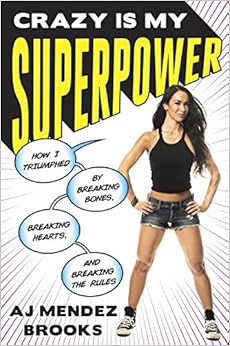
Book Review of Crazy Is My Superpower by AJ Mendez Brooks

I might just be the only person who read Crazy Is My Superpower by AJ Mendez Brooks without knowing from the outset that she was a professional wrestler. Actually, I had never heard of her before. I simply enjoy books in the memoir/autobiography genre, I wanted to read something by someone who was living with mental illness, and I liked the cover design, so I requested a free review copy from Blogging For Books. Then, I found out she was a Latinx nerd who grew up in poverty. Now, that is intersectionality. I was hooked. But, speaking of the cover design, I think it is really fun and attention-grabbing. It reminds me of comic book art.

One of the things I enjoyed about this book is that Mendez Brooks has a great voice... it is very authentic and casual. I felt like we were chillin' on her couch, playing video games and scratching her dog behind the ears. Reading this book was more like having a conversation with one of my guy friends than picking up a typical memoir. Also, Mendez Brooks doesn't shy away from difficult and painful subjects, nor does she attempt to make light of them. She also admits when she made bad choices, and takes responsibility for them. She has a winning attitude, and a personality that shines through from the first chapter, making her readers want to root for her, which is a key ingredient in any successful memoir. She also has the sense of humor of that girl down the hall in my dorm that all the guys used to love hanging out with because she'd win their burping contests.
Crazy Is My Superpower unpacks child poverty, domestic violence, homelessness and vagrant living, the realities of having teen parents (and one parent with severe mental illness), sibling relationships, academics, social issues at school, personal style, love of video games and dogs, respect, how women are treated in the professional wrestling industry, persistence, and so many more relevant issues. The writing quality is spotty, with some passages being so profound and wonderfully written that I had to stop and reread them many times because they bowled me over with their excellence, and others being so preachy, cheesy, or simply bad that I found myself rolling my eyes. Crazy Is My Superpower certainly could've used an editor with tighter reins on the project, since Mendez Brooks is a celebrity author, not a career writer, 

However, Mendez Brooks brought an unquestionable level of honesty to the table, no matter what issue she was discussing or painful childhood memory she was recounting at that moment on the page. The comics of her at each stage of life designed to introduce each chapter were one of my favorite parts of the book, and I looked forward to starting a new chapter just to see another one. The fact that I have literally zero interest in wrestling and had never heard of Mendez Brooks before picking up this book didn't keep me from enjoying it in the slightest. 

Of course, I'd recommend Crazy Is My Superpower to fans of Mendez Brooks and female wrestlers (or just wrestling in general), but I'd also recommend it to people who have an interest in memoirs about mental illness or child poverty, as well, and to teens who like non-fiction in general, as I think Mendez Brooks' conversational tone, candor, and inability to shy away from difficult topics will be most appreciated by that audience. Crazy Is My Superpower by AJ Mendez Brooks comes out today.

Sunday, April 2, 2017

Book Review of Road Food: An Eater's Guide To More Than 1,000 Of The Best Local Hot Spots & Hidden Gems Across America by Jane & Michael Stern


I'm back from my hiatus due to a family road trip, which makes this the perfect time to post my review of Road Food: An Eater's Guide To More Than 1,000 Of The Best Local Hot Spots & Hidden Gems Across America by Jane & Michael Stern. I requested a free review copy of this one from Blogging For Books specifically because I knew we were going on our trip and I thought we could try out this guide on the road before I reported back to my blog readers. The cover is an attractive vintage-y feeling map with a few favorite restaurants marked. It made me eager to flip through the book.

However, when I looked inside, I started with my own hometown to get my bearings, and I only found one entry. While my city isn't a huge metropolis like Chicago or New York, it is full of unique hidden gems if one knows where to look. Unfortunately, lame tourists (and the guides they tend to carry) are notorious for checking out only one disgusting hot dog shack that most locals I know can't fathom how the place is still in business or stomach their food. ...and Road Food's one suggestion for our town? It was just that very place. This made me extremely wary of the Sterns' picks for other cities, because I couldn't help but wonder if the locals in those towns felt the same way about those restaurants as my friends and I feel about the nasty hot dog restaurant the Sterns chose to represent my area.

Unfortunately, after putting Road Food to the road test, I can say that's exactly how the locals feel. Each pick that landed anywhere near our 1,200 mi route was overpriced and overhyped. Every time we asked someone we knew or a friendly face at a local gas station what they thought of the food at the eateries Jane & Michael Stern suggested, we were met with grimaces, frowns, and hearty warnings to eat elsewhere. Nevertheless, sometimes people can have a different take on a place because they're from the area. Maybe the owners of the restaurant are unpopular in the community, so their establishment isn't favored. Maybe it had a rough opening and nobody has been able to forget those initial bad experiences. So, we tried three of the restaurants recommended in Road Food. ...and, they were all expensive with food that was meh at best and disgusting at worst. One had okay service, and two had horrible, inattentive servers. Two were so lousy with charm that we could see how tourists like the Sterns might have been easily sucked in by the decor targeted at them, and one couldn't have had a more generic atmosphere. All they had in common was that they weren't worth visiting, and that the Sterns and Road Food had led us badly astray.

In addition to Road Food failing 3/3 times in terms of suggesting clean, affordable restaurants near our route with good service and yummy food, it failed on another level. For a book that has had so many printings, I was baffled to find that it didn't have a more effective system for travelers attempting to use it to determine where the restaurants contained within are located in relation to their route. For example, since the book is organized by geographical region, a transparent map of said region with the restaurants printed on it that one could lay on top of a trip route map and look for overlap might be a neat idea. Also, a useful indexing system, like being able to search in the back for eateries off of I-75, would be helpful. 

In short, Road Food is a hot mess. It is a heavy, cumbersome book that did nothing but lead us to waste time and money in gross restaurants that were disappointing. It also took up precious space in our small car. I'm not sure how it ever would've been helpful, but, in this day and age, the  vagabond diner is much better served by turning to Yelp and Google.

Sunday, March 12, 2017

Book Review of Every Body Yoga: Let Go Of Fear, Get On The Mat, Love Your Body by Jessamyn Stanley

Every Body Yoga: Let Go Of Fear, Get On The Mat, Love Your Body by Jessamyn Stanley is a unique book. It is part an instructional introduction to Yoga for beginners, part confessional memoir of a self-described fat Black femme Lesbian Yoga teacher, and part body acceptance guide. In short, if you want to do Yoga and you don't look like you've just breezed out of a Lululemon ad, this book is for you.

The unique thing about Every Body Yoga is not the full-color diagrams of Yoga poses with tips on how to begin doing them and suggestions for modifying them if the picture simply looks like something your body isn't going to do. The unique thing about this book is Stanley's voice: clear, self-confident, refreshingly honest and bullshit-free, conversational, and positive. She has been through all of the struggles herself (several of which are enumerated in chapters between the sections containing 10 sequences of Yoga poses, matching those chapters' themes), and it feels like she wrote this book to tell other people that it doesn't matter what someone's conceit of a Yoga practitioner is--it only matters that they're open to the experience and not open to allowing some ignoramus to ruin it for them by body shaming them or refusing to help them modify poses to what works for them.

Stanley is constantly aware of social issues rampant in the modern Yoga business (and, she is quick to point out that what once started as a way of life has turned into a materialistic business), such as ableism, cultural appropriation, and body shaming. She has a very "you do you" attitude about the whole endeavor, and is just as quick to tell her readers what they actually do need to dip their toes into the Yoga waters (it is very little), as opposed to what people might tell them is needed, especially if those people are the same ones who sell it. Stanley also comes from a working-class poor background, so she understands that some of her readers who would love to practice yoga don't have the funds to pay drop-in fees for classes (she advocates home DIY, with guidance from the Internet and her book), or purchase much equipment (she has a clear guide on how to improvise most of the items a beginner may require. This book was a night-and-day difference from the travel packing guide I reviewed recently, because I could tell it was written for every person (from the perspective of someone who had frequently been shut out of others' short invitation lists), so she really got it when it came to things like physical limits, psychological roadblocks, body shame, and financial struggles. 

But, more than that, reading Every Body Yoga didn't just feel like a crash course in how to use Yoga to feel better and more uplifted, it felt like Stanley came off of the page and introduced herself. Her presence was undeniable! None of that "namaste" crap here--she used the f-word on the regular. Her words on the page sounded exactly as if someone's telling a friend about "this crazy thing that happened at Yoga class last week," or "here's when shit got real back in college." Readers will walk away from her book with an understanding that the door to Yoga (which they may have previously assumed was closed to them for various reasons), is open to all, and that they have an authentic person supporting them from the other side of these pages. I can't recommend this one enough! It comes out on April 4th.

Saturday, March 11, 2017

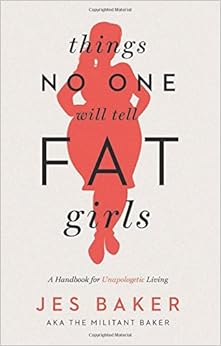
Book Review of Things No One Will Tell Fat Girls by Jes Baker

Things No One Will Tell Fat Girls by Jes Baker is part self help book, part introduction to the body acceptance movement, and part collection of essays from authors of varying perspectives on issues pertaining to being fat. Other contributors to the book are: Virgie Tovar, Sonya Renee Taylor, Andrew Whalen, Jen McLellan, Shanna Katz Kattari, Kimberly A. Peace, MSW, Sam Dylan Finch, Bruce Sturgell, and Chrystal Bougon. Jes Baker is the writer of the Militant Baker blog, and famously took Abercrombie & Fitch's CEO down a few pegs after he admitted to discriminating against fat people by posing all sexylike in one of their shirts (which wasn't supposed to fit her).

With chapter topics ranging from self care to fatshion, fat and health, body unacceptance throughout history, media representation of fat bodies, and mental health support, Things No One Will Tell Fat Girls is a well-rounded (pardon the pun) resource for anyone with a well-rounded physique. As a fat girl myself, I particularly appreciated the section on how to seek and attain good health care and work around the misconception that all health problems a fat girl may have are caused by her weight. I have also always appreciated the fact that Baker comes right out and uses the word "fat" repeatedly, unblinkingly, and without issue, because that's what I do! It isn't necessarily being down on yourself... sometimes if you're fat and you are at peace with it, you are simply able to say you're fat and move on with life! This attitude is refreshing, because, no matter what size you are, beating yourself up about your weight will get you nowhere.

Most of all, Baker's strength lies in the fact that she views all sources with a critical eye. From TV shows to magazines, from Instagram feeds to "friends," Things No One Will Tell Fat Girls reminds readers repeatedly that everyone has their own agenda, and only some people are actually out to help fat girls. The rest? They mostly just want to make money. So, from the publishers of her own book, who put an hourglass-shaped silhouette of a fat girl on the cover (which Baker points out and deconstructs) to retailers who sell "plus-sized clothes" that top out at size 16, Baker is ready to dissect the bullshit and give her readers the skinny on how to filter out unneeded negative influences from their fat lives. For some, this will be a challenge--retraining your brain doesn't happen overnight. But, it is still worlds better than allowing those who stand to make a buck from your insecurities control how you view yourself. This is a healthy tome full of good body acceptance information and peppered with diverse perspectives (trans, disabled, WoC, and more). If you're fat, you know someone who is and want to be more sensitive to their needs, or you just want to find out what the whole body acceptance movement is all about, Things No One Will Tell Fat Girls is definitely worth a read.

Monday, March 6, 2017

Book Review of Writing My Wrongs: Life, Death, and Redemption in an American Prison by Shaka Senghor

While I'm not Black, male, or possessed of a criminal record, the topic of Writing My Wrongs by Shaka Senghor is a very personal one to me. A member of my immediate family went to prison on felony charges when I was in elementary school, and was gone for what felt like half a lifetime. In Writing My Wrongs, Senghor describes a life on the street in which he had many things working against him. An unstable home, abuse, and choosing to leave that environment as a teenager led him to live on his own. After quickly learning that his lack of even a high school diploma would make it impossible to support himself independently, Senghor was offered a chance to get into drug dealing on the lowest level, and he took it. His autobiography is the story of what happened next.

For those of us who have never been incarcerated, we can only gather secondhand information about what it is actually like. Senghor has one word which sums up the experience eloquently: dehumanizing. There are things this book does not do well. After reading it, I still cannot explain why anyone would choose to tell a story like this in such a fragmented, out-of-order way, with no cohesive timeline for the narrative. Every time I reached a new chapter, I longed to re-order all of them so that I could read chronologically, which I felt would've made more sense, and also helped me understand Senghor's journey through the underbelly of Detroit's east side in the 1980s and the American Prison System. Also, there were several small inconsistencies within the narrative. They didn't discredit Senghor's message, but they were frustrating and distracting, and I felt they would've been easily caught and fixed by an editor who was a bit more on-the-ball.

Ultimately, though, Writing My Wrongs is a book with much to offer. Senghor speaks from a population which has traditionally been ignored. Senghor spent a total of nineteen years in prison, seven of which were in solitary. How many books have been published by writers who have committed multiple violent felonies? I don't have the statistics, but I read widely, and I've only heard of a handful. He offers up his own life as an example of how easy it is to make bad choices. Senghor freely admits that he isn't perfect, and he is eager to point out where his thinking was flawed. More than anything, desire to be a good person, a decent role model, and a positive father figure came from this book in waves. Writing My Wrongs both gives an important perspective on the failings of the U.S. Justice System, and a personal look at a life partially wasted. Though the writing itself isn't artful, it is compelling, honest, and important.

I don't usually include other links with my book reviews, but this is a short informative video about Mass Incarceration in the US, and I feel it sets the stage nicely for Senghor's story. Thank you to Blogging For Books for providing me with a free copy of this book in exchange for my honest review.

Friday, March 3, 2017

Book Review of How To Pack: Travel Smart for Any Trip by Hitha Palepu


How To Pack: Travel Smart for Any Trip by Hitha Palepu is exactly what it sounds like: a non-fiction guide to packing for trips. However, the title is a bit of a misnomer, because the book isn't really about packing for ANY trip--Palepu's main focus, which is very accentuated, is on air travel. Since most of my travel consists of road trips, with the occasional rail excursion thrown in, I found this to be a disappointing and frustrating oversight (probably on the part of someone at the publisher, rather than Palepu, herself), so I wanted to make sure readers understood that going in. However, The cover is a completely adorable mock-up of a suitcase, complete with a faux luggage tag graphic featuring the title and author. (The brown parts which are made to look like leather actually have a different texture and feel.) So, I'd say the cover design is a total win.

How To Pack has some good features--most notably, an end section comprised of perforated packing lists, all ready to tear out and use. They are laid out in the format Palepu recommends (and demonstrates earlier in the book), and this is a real value-added component for travelers. However, most people could simply print a packing list online, and such a list would be more easily tailored to their specific needs. The illustrations are cute and helpful. Common packing strategies and methods (fold vs. roll) are debated and illustrated.

In addition to the fact that a book subtitled "Travel Smart for Any Trip" is really only focused on air travel, and not other types of travel at all, I have a few other complaints. ...my first (and biggest) one being that a book with lists and diagrams and such, designed for people to use while doing something active with their hands--such as packing--should've been made to lay flat on the surface of the packing station Palepu repeatedly recommends. This was a huge oversight on the publisher's part. Also, Palepu suggested many specific go-to products for traveling and packing. Since the end section of the book is comprised of perforated pages, why didn't the publisher think to add a tear-out list of Palepu's product recommendations with contact information on where they can be purchased? That seems like a handy little extra the publisher should've thought of. (Hmmm, so far all of the negatives are oversights on the publisher's part....) 

My complaints about things more within the authors purview are numerous, as well. The flow-chart-style guide for selecting which type of suitcase would be best is confusing, and would've benefited from both clarification and illustration. Many of these packing tips feel recycled, and I've heard them time and time again. Is Hitha really a travel expert, or did she just have a subscription to Real Simple in the early 2000s? Also, her product recommendations are absurdly priced. I'm not sure who exactly her target demographic is supposed to be, but if she was going to make a habit of telling me to purchase things to help me do a better job of packing that cost more than my trip does, she could at least have the decency (and creativity) to include a list alongside it of budget-friendly options alongside the splurges. Or, even better, some suggestions for handy around-the-house substitutes instead of stuff that has to be bought specifically for this purpose--things that maybe don't have lifetime warranties or cost as much as the average person's rent in my world, but will help someone get organized before their trip in a pinch. That type of inclusion might have made this book worth buying. 

Also missing in action: a discussion of which fabrics do the best when packed, any tips specific to car travel (how to pack a car for a road trip, for example) or train travel, tricks for how to pack necklaces without them getting tangled, suggestions on packing medications, and what to do if you don't want to spend your whole trip wearing dirty clothes, as she suggested. How To Pack should really be called How To Spend Money On A Book When You Could Find Better Information More Suited To Your Needs For Free Online. But, since the advice is tailored to rich people who fly a lot, they probably won't care anyhow. Thank you to Blogging For Books for the free book provided in exchange for my honest review.

Sunday, January 29, 2017

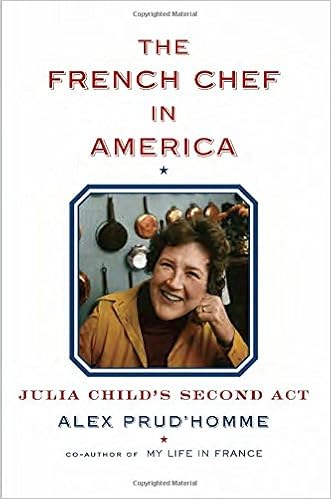
Book Review of The French Chef In America: Julia Child's Second Act by Alex Prud'Homme


In The French Chef In America: Julia Child's Second Act, Alex Prud'Homme (fully qualified to write on the subject because of his relationship to Child as the grandson of her husband's brother) captures her essence. For those who read and loved My Life In France, which he authored with Child herself, Prud'Homme considers this a sequel, of sorts. ...and, like the subject herself, it is delightful.

Readers will notice certain differences between this and the standard biography right from the start; it has a more lively conversational tone, entertaining pictures are interspersed throughout the book instead of grouped together in one middle section, and Prud'Homme's own familial relationship with Child adds a level of personal warmth and friendly regard not usually lavished upon most biographical subjects. These traits combine to make reading The French Chef In America a tasty morsel, worthy of Child's own kitchen.

For those with an interest in Julia Child, the American historical and political landscape of the 1970s, and Child's most meaningful personal relationships, including her marriage to Paul Child, her friendship with editor Judith Jones, and her unoffical sisterhood with her co-author Simca Beck, this book will serve to delight and inform. Highly recommended.

Thank you to Blogging For Books for providing this free review copy in exchange for my honest review.