Showing posts with label MG. Show all posts

Wednesday, May 17, 2017

Book Review of York: The Shadow Cipher by Laura Ruby

Since I read Bone Gap, I've added Laura Ruby to my list of must-read authors, so I was very excited when I received an arc of The Shadow Cipher by Laura Ruby in the mail, free from the publisher for the purpose of this review. Unlike Bone Gap, however, The Shadow Cipher is a middle grade book, and the cover says it is geared toward kids ages 8-12 or grades 3-7. The Shadow Cipher serves an underserved audience: younger, more advanced readers, with higher critical reading abilities and higher lexile scores. From working in a bookstore for several years, I know that kids in that demographic are hungry for longer books (this one clocks in at 448 pages) that have content their parents or teachers will deem age-appropriate, that don't condescend to them, and have a more advanced plot with plenty of twists and turns to keep them on their toes as they read. I was just such a kid, and having to choose between books teachers might have frowned upon me reading because of their "inappropriate" content, and books that I zipped right through because they were short and too easy to read was a constant problem. Ah, if only The Shadow Cipher had been around for me! And, the best part? The Shadow Cipher is the first book in the York series, so there will be more to come.

I must say, though, I'm not a fan of the cover. While it does accurately depict the three main characters, it doesn't represent the setting well. Most of the book is set in the mysterious and wondrous Morningstarr apartment building, and a cover featuring either the interior or exterior of that all-important structure would've been much more effective.

I am ultra picky about MG titles. I have my favorite authors in that reading level (E. L. Konigsberg, Kirsten Miller, Lois Lowry, Blue Balliett), and I've found many other reading ventures to be disappointing. The Shadow Cipher felt like a mix of Kiki Strike by Kirsten Miller and Chasing Vermeer by Blue Balliett, which is a huge compliment coming from me, and it also reminded me of another beloved title: The Westing Game by Ellen Raskin.

Ultra-intelligent and observant Tess and Theo Biedermann, fraternal twins, and their resourceful and charming friend and neighbor Jaime Cruz (all three seventh-graders) are trying to save their beloved Morningstarr apartment building from an evil real estate developer by solving the infamous centuries-old Old York Cipher, an encoded puzzle built into the very fabric of this alternate reality version of New York city by Tess and Theodore Morningstarr (after whom the Bidermann twins were named). Though many tourists and puzzle mavens alike have attempted to solve the cipher, none have succeeded in claiming the promised treasure awaiting the victor at the end of the riddles. Can three seventh-graders do what countless adults have failed to accomplish, and also save their beloved home?

The characters and story were so engaging that reading this book in one sitting was a total breeze--I didn't want to put it down! Two of my favorite characters are some of the most unexpected personalities to appear in the book. Six-year-old Zelda "Cricket" Moran pairs ballet tutus with skull and snake bedecked t-shirts and bridal gowns accessorized with gas masks... or, maybe it was scuba gear? Clueless adults might pass over her quirky ensembles as those of a child merely playing dress-up, but Cricket is always costuming herself for a part... sometimes, a role so obvious someone who didn't know her would miss it completely. She trafficks in the highly-prized commodity of secrets, and has the powers of observation only a child frequently ignored by those who assume they're more important than she could possess without attracting notice. Cricket also busts out SAT words like there's no tomorrow, and she uses them correctly and sincerely, which made me smile every time.

The Biedermann twins' Aunt Esther is introduced when she presents them with a large spotted cat, and says, "I have brought you an animal. This animal is called Nine Eighty-Seven. I have also brought you some Fig Newtons. But not for the animal." From there, both her eccentricity and her keen awareness of what matters most to her young relatives and her treatment of those priorities as sacrosanct reign supreme in her ultimately witty and endearing characterization.

Pleasingly for this diverse book reviewer, Shadow Cipher is rife with diversity. Of the main characters, Jaime Cruz's grandmother actually emigrated to the US from her native Cuba, and the Bidermanns are Jewish--Ruby incorporates plenty of Cuban and Jewish cultural references and Yiddish words, and all of the Jewish references are completely on-point and were delightful, appropriate, and enjoyable to me as a Jewish reader. Also, Tess seems to have some sort of unspecified anxiety disorder, resulting in her having a service animal--the cat, Nine Eighty-Seven. Though her disorder is referenced (respectfully and consistently), it is never explained explicitly. Ruby seems to go out of her way not to call things or people "crazy" or "insane," instead using words like "bananas" is sometimes used to describe strange or unbelievable situations, thus making The Shadow Cipher very sensitive in terms of neurodiversity.

My one complaint about this book is the HUGE cliffhanger of an ending and the fact that I can't find the release date of book two anywhere. Highly recommended.

Sunday, April 9, 2017

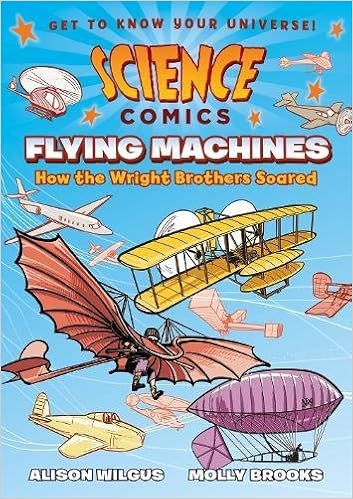
Book Review of Science Comics: Flying Machines: How the Wright Brothers Soared by Alison Wilgus and Molly Brooks

The latest installment of Science Comics, a series of non-fiction graphic novels catering to an MG reading level and audience, is Flying Machines: How the Wright Brothers Soared by Alison Wilgus and Molly Brooks. If you aren't familiar with the Science Comic series from :01, each volume features a full, information-packed narrative explanation of the titular concept, which has been reviewed by an expert in the field. After the guided tour, which reminded me of a more in-depth lesson from Miss Frizzle herself (win!), and is tailored to readers ages nine and up, the book also includes a section of notes and a bibliography for readers whose interest hasn't been quelled by just this one volume and who would like to learn more about the topic at hand.

In this volume, author Alison Wilgus introduces readers to a historical figure they may never have heard of: Orville and Wilbur Wright's younger sister Katharine. Just like many little siblings, Katharine took a great interest in the exciting project her big brothers were involved with, and was their biggest champion along the way. She was an interesting choice to serve as a narrator for the story, because many readers of Flying Machines have no doubt either been the little sibling who watched from the sidelines, or had such a brother or sister. Also, it is surprising to note that she was so integral to the Wright brothers' development of their flying machine, but that, without having read this book, I never would've heard of her. Katharine really humanized the narrative, adding in colorful commentary and emotion, and keeping Flying Machines from being simply a list of historical dates and facts. It was an effective storytelling choice, for sure!  One of my favorite parts of the book was the mini biography of Katharine Wright included near the end.

I also appreciated that Flying Machines incorporated a depiction of the race to invent a flying machine. Many kids (including me) probably grew up with the belief that the Wright brothers were the only ones working on such an invention, so I think it is important to note that, actually, several other parties were toying with similar ideas at the time. It was fun to see how they fed off of each other's concepts, and how one person's obstacles might lead to another inventor's breakthrough.

Molly Brooks' illustrations really won the day. Her drawings of planes (and other mechanisms) in flight really captured the motion of each one, so they came alive from the page. Reading Flying Machines was kind of like watching a Miyazaki film, due to her lively and imaginative drawings. I also loved the colors she selected for the settings and clothing of her characters--the warm brown and gold tones and cool blues really added to the story and set the time period in my mind. Brooks' depictions of Orville and Wilbur made them stand out in my imagination, whereas when I'd read about them previously, the brothers were somewhat interchangeable. Her characterization of Katharine was endearing and kept me interested even in parts of the story where the narrative lagged where it was held down a bit by lots of technical detail.

Coming out on May 23rd, teachers, parents, and aviation fans alike will be thrilled by this detailed, educational graphic novel history of the origins of heavier-than-air flying machines. You can preorder it now. If that isn't enough, previous titles in the series cover coral reefs, dinosaurs, volcanoes, and bats. (I really wish I'd gotten my hands on the one about dinosaurs, myself, as anyone who knows me knows my love of dinos is deep and profound!) I can really see these books being useful for science teachers or homeschool parents to build lesson plans (especially with the bibliography, glossary, and notes inclusions at the end of the texts), or as wonderful gifts for curious scientifically-minded young readers to learn independently, because of the lively dialogue and colorful illustrations. But, even as someone who isn't particularly interested in flight, and who read the book as an adult, the strong partnership of Wilgus' writing and Brooks' illustrations kept me hooked until the very last page. Highly recommended!

Wednesday, April 5, 2017

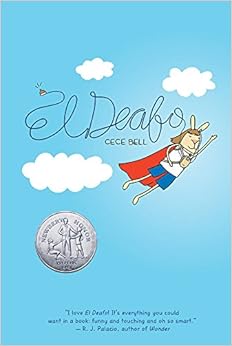
Book Review of El Deafo by Cece Bell

I wanted to read (and review) El Deafo by Cece Bell for three reasons. One is that, thanks to a crappy immune system, I've had over a hundred ear infections (and tubes three times) in my life, and I'm lucky to still be able to hear, but I never want to take that for granted. Two is that, of course, it fits right in with my mission as a Diverse Book Blogger. (Click the link in the right sidebar for more information.) And three is that sign language and Deaf culture are very important to my husband, a teacher who has some Deaf and hard-of-hearing students, has volunteered at a Deaf camp, and is trying to start an ASL club at his school currently. So, when he mentioned wanting to read this book, I figured I'd join him. His book pick was solid, and I was far from disappointed. I just love the cover. The way the characters are drawn in this book really reminds me of the Arthur books, which I really enjoyed as a kid.

El Deafo is Cece Bell's graphic novel autobiography of becoming deaf and navigating childhood afterward. A cartoonized Cece (sometimes the caped superhero version she imagines of herself, the titular El Deafo) deals with friendship drama, classroom challenges, hearing aid malfunctions, unnerving doctor's appointments, scary sleepovers, and feelings about her sudden hearing loss. If there is one basic throughline of the story, it is Cece learning to live with her deafness and figuring out who her real allies are during a difficult time of change and growth.

El Deafo could be useful to hearing kids who want to understand what Deaf or hard-of-hearing kids are going through. Bell takes the time to explain things step-by-step, such as how to speak if someone is trying to read your lips, or how to be considerate of a Deaf or hard-of-hearing friend without patronizing them or making them feel different. It could also be beneficial for adults who work with Deaf or hard-of-hearing kids, though, obviously, it is written at a MG reading level and the material is presented for that audience, because Bell also points out some of the obstacles she faced in the classroom, which teachers and other adults could've been better prepared to help with. And, though I'm not Deaf or hard-of-hearing, I wonder if it wouldn't also be great for those readers as well, especially if they are MG reading level, because they might feel sympatico with Cece when she explains how frustrating it is when hearing people don't understand some of the challenges she faces, or what a relief it can be to simply turn off her hearing aid when she wants quiet.

What's wonderful about El Deafo is Bell's emotional honesty, and the fact that she was clearly prepared to explain difficult concepts and share painful feelings for the benefit of her readers. Also, the character of Cece is so lovable that I rooted for her from the first page, and even if I'd had no interest in the subject matter, Cece's sympathetic character would've kept me reading until the end.

Sunday, March 19, 2017

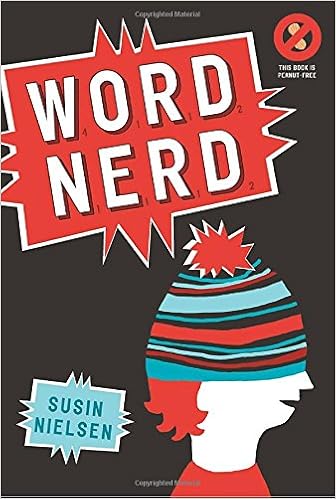
Book Review of Word Nerd by Susin Nielsen


Word Nerd by Susin Nielsen came to my attention because a fellow diverse book blogger posted on the linkup (link to the right--just click the picture) about it. As someone with several anaphylactic allergies, I was curious about it. As someone who loves word games, I was curious about it. In short, I put it on hold at the library and had it in my hot little hands all in less than 48 hours (aren't libraries and librarians awesome?). I find the cover delightfully original and quirky, and it definitely represents the book well.

Word Nerd is the story of a twelve-year-old Scrabble lover named Ambrose. Also, peanuts could kill him. Ambrose encounters bullies, convicts, drug dealers, a busty waitress, and Scrabble-playing misfits, and he navigates each situation creatively and with a spirit that will make readers smile, even if he isn't the most smooth operator on the page. (He really isn't.) He is, however, highly endearing.

This book feels like it was narrated by the kid from the TV show About A Boy. The voice is that strong, guys, and the dynamics are very similar (slightly odd boy being raised by a super loving but overprotective single mom with a new single adult male whose influence mom questions being thrown into the mix as a potential friend).

Also, I love the way it dealt with the issue of life-threatening allergies, because having them is like walking a tightrope: you want to be careful so you don't die, but you also don't want to let fear of encountering your allergen(s) stop you from living life. Though Ambrose has a pretty healthy attitude about this issue (to make up for his unhealthy immune system), his mom reacts to his health problems with an overprotective instinct. I saw many of my own Mom's behaviors from my childhood as an allergy kid reflected in her character.

I liked how it helped the reader understand the skills required to be successful at Scrabble. I also liked how each chapter title was displayed scrambled (as if made of Scrabble tiles) and then the list of its potential Scrabble words was printed below it. I thought the publisher could've easily made the more visually-appealing choice to replace these words with a graphic of a Scrabble tile rack with those letters shown in tile form, and then with the potential Scrabble words printed again in tile form beneath it, both for interest, and also to better illustrate how the game of Scrabble works for younger readers who may not have previously encountered it. 

My one complaint about Word Nerd is that, though I always love it when kids in books read (how meta), and when kid's book authors recommend other kid's books, it was super awkward the way Nielsen chose to do this. Her not-in-the-least-bit-subtle name drops of her favorite books really took away from the story and pulled the narrative out of a extremely effective voice because they felt like an adult interrupting the story to tell readers that, if they liked her book that they're currently reading, they should also check out these others. (And it wasn't even half as slick as LeVar Burton's, "But you don't have to take my word for it.") 

While I applaud Nielsen for encouraging her readers to take a look at other books, and finding a way to give a shout-out to authors she likes, I felt like this could've easily been done in a more artful way by paring the list of suggested reading down to books that applied to Ambrose's various situations, and then weaving them into his commentary on what was happening in his life. (For example, when Ambrose *very slight spoiler* is hitting on the middle-aged waitress, maybe have him reflect on that situation later and then check out 'Geek's Guide to Dating' from the library, instead of just listing off that he has read something else and then moving on. This would've also heightened the comedy of their previous interaction, and underscored that he accepts his identity as a nerd, and that he is good with it.)

Either way, I highly recommend Word Nerd. I enjoyed it enough that this book is now on my wishlist to purchase when it fits my budget. I would also like to note that many people who are participating in the Diversity Bingo 2017 challenge are looking for books with an MC with an anaphylactic allergy, and this one has great representation for that category.


Friday, March 17, 2017

Graphic Novel Week: Awkward by Svetlana Chmakova: A Book Review

Welcome to Graphic Novel Week! This is a non :01 graphic novel, but I recently dug up this vintage review of mine, and I wanted to bring it out again for graphic novel week because Svetlana Chmakova is one of my favorite graphic novel artists/illustrators, and she has a new book coming out in May, called Brave.

I discovered this book by accident during a bookstore run, and I'm THRILLED that I did, because I absolutely adore Svetlana Chmakova's Dramacon manga miniseries. (Sidebar: the hubs and I were tight with a group of manga/anime fans in undergrad. We were kind of on the fringes of the group, but somehow got roped into going to an Anime Convention, which was excellent, btw, so I really identified with the whole portrayal of the convention in Dramacon.) I really enjoy the cover design, because the body language of the two characters in the foreground totally conveys awkwardness!

I love that the protagonist, Peppi, (pictured on the left side of the cover) breaks all of her personal rules for social success as the new girl in school, but still manages to triumph at the end. Though she and Jaime (right) get off to a rocky start and have different interests: art--Peppi, science--Jaime, I really enjoyed how they built not just a friendship over the course of the book, but a partnership between archrival school clubs (art and science). Sidenote: I didn't realize school clubs HAD archrivals within their own schools. Who knew?

The colors are lovely and muted. The characters are personable and falliable. The plot is quick-paced and exciting. Everything about this manga is quirky and enjoyable. I highly recommend it, especially for middle schoolers who have a strong interest in art or science, or those who are nervous about encountering a new school.

Thursday, March 16, 2017

Graphic Novel Week: Secret Coders: Secrets & Sequences by Gene Luen Yang & Mike Holmes

Welcome to Graphic Novel Week! This week, I will be posting reviews of graphic novels, specifically ones from :01, which is a favorite graphic novel publisher of mine. Here's a link to their website.

So, Secret Coders: Secrets & Sequences by Gene Luen Yang & Mike Holmes is the third book in the Secret Coders series of MG graphic novels. The first volume (Get With The Program) was awesome! (Scroll down two reviews to read about it.) The second one (Paths & Portals, review is just below this one) had some issues and felt more like a cartoonized computer programming workbook. With one hit and one miss already in the series, I wondered if Yang and Holmes would be able to capture the magic of volume one, or if they were doomed to repeat the mistakes of volume two in the third installment of the series. I requested a free copy of this book in exchange for my honest review to find out. While #3 feels much more like the story-driven #1 instead of the workbook-esque #2, I am still not a fan of these cover concepts. However, that is one of my few complaints.


Luckily for readers, Secrets & Sequences delves more deeply into the mysterious conflict happening at the Bee School. Hopper continues to try and solve the riddle of her father's disappearance, and she and her friends do their best to outwit the diabolical Dr. One-Zero. 

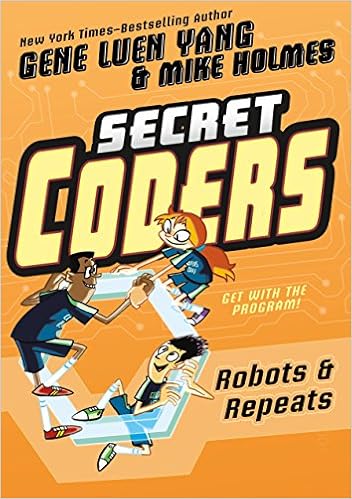
One of the best aspects of this book is that it shows how understanding computer coding gives the kids agency and illustrates that these skills enable them to fight back against injustice or feelings of powerlessness--a timely message in today's world. The story has a great balance of action and character development, and there's plenty of coding still happening, including a few mini lessons where kids (or, really any readers) who are reading along and want to learn computer coding can stop and work out the problems for themselves. But, because Secrets & Sequences is so much more character and plot-driven than its predecessor, it never feels like a workbook. This is a win, and it makes me excited for the release of volume four: Robots & Repeats, which is due to hit shelves on October 3rd. I will be reviewing it later this year, but here's a peek at the cover:


Graphic Novel Week: Secret Coders: Paths & Portals by Gene Luen Yang & Mike Holmes

Welcome to Graphic Novel Week! This week, I will be posting reviews of graphic novels, specifically ones from :01, which is a favorite graphic novel publisher of mine. Here's a link to their website.

Since the first graphic novel in this series (Secret Coders: Get With The Program) knocked my socks off (see the review just before this one), I requested a free copy of the second book from the publisher in exchange for my honest review. The things I liked about book one were the well-developed characters, the playful attitude of the story, and the amazing way it demonstrated binary visually so that I could understand the concept. Unfortunately, Book Two (Paths & Portals) does not share many of these positive qualities. However, it does have its own strengths to add to the mix.

In Paths & Portals, it seems that the true mission of this graphic novel series has been revealed. What felt like a fun foray into computer programming designed to get kids interested in the field now feels like a cartoonized computer programming workbook. Instead of a graphic novel adults could also enjoy, book two had almost no entertainment value for readers who might not want to work alongside the kids in the story to do the computer programming exercises. While I can see how Paths & Portals would have tremendous value within a STEM classroom setting, or even as fun reading for a kid with a burgeoning interest in computer programming, shifting the focus from a mystery involving programming to actual repetitive-seeming computer programming exercises reduced character development and all but stopped the progression of the story in its tracks, and replaced those necessary elements with what felt like little more than a workbook.

I finished book one feeling excited and eagerly anticipating the next volume in the story. But, since reading book two, I wonder how much story will actually be told in the subsequent volume. Using graphic novels to teach computer programming and get kids interested in the field is great, but I wonder how effective the strategy is when it comes at the expense of action, plot, and character. Will these issues be solved in volume three? My review of Secrets & Sequences will be up later tonight. Stay tuned!

Graphic Novel Week: Secret Coders: Get With The Program! by Gene Luen Yang & Mike Holmes


Welcome to Graphic Novel Week! This week, I will be posting reviews of graphic novels, specifically ones from :01, which is a favorite graphic novel publisher of mine. Here's a link to their website.

Secret Coders: Get With The Program! by Gene Luen Yang & Mike Holmes is one of the most amazing graphic novels I've encountered (at least for kids), because it managed to explain binary code in a way that I could understand, and even found fun! Despite the front cover illustration (which I found moderately off-putting, I must say), I found the back cover illustration simply marvelous and the back cover text intriguing.

Then, I opened the book, and my adventure began. The whole volume clocks in at just under 100 pages, which, in graphic novel terms, means it translated into about a 20-minute time commitment for me. I was drawn into the story immediately, as I usually cannot resist the tale of a young girl becoming acquainted with her new surroundings right after being forced to move to a new town by her parents (see: Spirited Away, Nightmare, and many other perennial favorites), and I was along for the ride as Hopper confronts her new school, and all that it has to offer.

From there, I was dragged along as Hopper and her new potential enemy-turned-friend, Eni, follow a robotic turtle down the rabbit hole in an exhilarating chase through their school grounds to find out just why the birds populating their campus are so creepy, who is posting numbers all over the walls, how to use computer coding to get robots to do their bidding, and what is wrong with all of the adults at their school. (No, seriously... more than normal; something's really wrong here!) In the ultimate cliffhanger ending, book one finishes way too early in the plot to leave readers anything but salivating for book two, Secret Coders: Paths & Portals.

Though it may not be super important, I do appreciate that the book is printed in black, white, and green (instead of greyscale), in what I can only assume is a witty homage to ancient computer screen displays! It took me right back to the olden days of C:Batch files of yore! Am I right, older readers?

If you're an adult who likes mysteries and or computer coding, or you want a book for a middle schooler (or perhaps even a high schooler) with those interests, I don't think you could go wrong with this one! I highly recommend it as an entertaining and educational read. I received a free copy of this book from the publisher in exchange for my honest review.

Graphic Novel Week: The Time Museum by Matthew Loux

Welcome to Graphic Novel Week! This week, I will be posting reviews of graphic novels, specifically ones from :01, which is a favorite graphic novel publisher of mine. Here's a link to their website.

For those of you who have been following along with graphic novel week, you may have noticed that the first three reviews were of books for teens and adults. However, The Time Museum, by Matthew Loux, is the first volume in a middle grade series about Delia, a science nerd character with lots of agency. I strongly dislike the cover, because I felt having all of the characters look down at their wrists or at the ground and not being able to see anything but the building shut me out of the scene as the viewer. I also disliked that the girl one in from the left in the blue headband looked so much like the girl who was front and center (before reading it, I presumed that was Delia, the protagonist), and I wondered if they were both supposed to be her in different times, or if there were just two characters who looked so similar to one another. Either way, it was confusing and did a poor job of setting the mood or scene for me. Also, it didn't do well at showcasing the vibrant colors which come alive within the book.

Delia, a smart, awkward girl, knows she'll be visiting her Uncle Lyndon over the summer, but she doesn't know he works at a museum with exhibits from all eras of time, and portals to those eras. Delia also doesn't know that she has the chance to compete in a contest for an internship position within the museum, and she'll have to travel back and forth through time to complete the challenges, besting five other kids--competitors from different time periods. 

I really had trouble buying in to this story. The whole setup felt too stilted and contrived. The commentary as the kids wander through the museum didn't feel natural to me, at all. I felt Delia had honest emotional responses to whatever situation she was in, but I really wished I'd been able to read more scenes of quiet conversations with just her and her roommate to better understand both characters and observe their dynamic in a quiet setting before things got crazy. As the book progressed, I felt like there was too much action and chaos, and not enough character building and development to keep me interested. I longed for the characters to have more personal connections with the historical exhibits they were experiencing, instead of just clowning around. The colors were beautiful and the glossy pages decadent, but the art style really grated on me the more I read. All in all, I only finished the book because I was reviewing it, and I wouldn't pick up the second volume. I don't recommend this one.

(As a point of comparison, other middle grade graphic novels I have liked are the Secret Coders series, Awkward by Svetlana Chmakova, the Bone series by Jeff Smith and El Deafo--reviews to come.) I received a free copy of this book from the publisher in exchange for my honest review.

Saturday, February 11, 2017

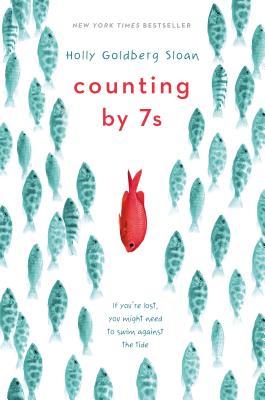
Book Review of Counting By 7s by Holly Goldberg Sloan

Counting By 7s by Holly Goldberg Sloan has earned is place on my bookshelf, right next to The View From Saturday and The Mozart Season. It makes me wish I was working as a children's librarian or a teacher, so I could put this book into dozens of young hands. (Instead, I told several teachers and librarians about it, which works just as well for me.) The cover concept is simple, but breathtakingly beautiful, and it represents the story wonderfully.

In a time when so many readers are clamoring for diverse books, and books that portray characters with differing abilities, Counting By 7s isn't just a great book, it is also a very needed one. It will speak to kids dealing with loss, social anxiety, questions of belonging, adoption, and identity. (On some level, isn't that pretty much every kid?)

Willow Chance is an endearing protagonist, but her prioritization of logic over all else leaves many people scratching their heads after interacting with her. When tragedy strikes, Willow doesn't process it the same way most kids would. She also doesn't have the tight social bonds to fall back on that most kids would have. However, she does have an extraordinary body of knowledge about scientific topics that interest her. As Willow learns to apply this knowledge in a way that can help those who are in a position to help her, she is able to forge her own bonds. Holly Goldberg Sloan captures Willow's dynamic journey in a refreshingly forthright way, not glossing over the fact that Willow won't be making new friends by fishtail braiding their hair or giggling together over boy bands, but highlighting that Willow's knowledge of disinfectants and understanding of fungus and insect infestation can also be worthy social currency, and shouldn't be discounted. What Counting By 7s says most of all is that Willow shouldn't be discounted simply because she is different, and it does so eloquently.

This book is truly a must-read.