Showing posts with label graphic novel. Show all posts

Monday, May 29, 2017

Book Review of Crafty Cat And The Crafty Camp Crisis by Charise Mericle Harper

As I mentioned in my review of Yellow Owl Workshop's Make It Yours here, I have always been into crafts. I was the kid who would rather receive a gift card to Michael's than Toys R Us any day. So, that, combined with my deep-seated love of graphic novels (especially the offbeat ones published by :01, the publisher of the Crafty Cat series), led me to request a free review copy of Crafty Cat And The Crafty Camp Crisis by Charise Mericle Harper and see how these two interests of mine would mesh. Note: The Crafty Camp Crisis is actually the second book in the series, but it is easy enough to pick up and follow along without having read book one. I didn't have access to the first volume, myself, and I was able to track with the story in volume two just fine.

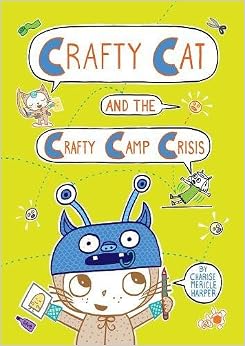
I wasn't a big fan of the cover design. Though I liked how it featured both Birdie and her alter ego, Crafty Cat, and I thought it was cute that the title and author were displayed in dialogue bubbles, there was too much going on at once, with too many small details and not enough larger images, and the chaos got in the way of using the cover to gauge an overall mood or theme for the book.

However, the cover does give a good representation of the illustration style used within the text. The pictures have simple lines and a palette of only a few colors, and they look as if a child (albeit, a talented one) would've drawn them, giving an air of youthful fun. One of Harper's strengths is conveying facial expressions, and I noticed her characters eyes and mouths always seem to show very effectively how that person is feeling, which should help younger kids who aren't strong readers use context clues to read the dialogue. Also, the text is difficult to read in some graphic novels, so I appreciated that it was a little larger than normal and clearly legible here, as kids this young would probably simply give up, rather than trying to decipher print that was too small, or a font that didn't quite look like the lettering they're used to.

As one would expect of a graphic novel for 6-10 yr olds, the plot is kept relatively simple. Birdie (aka Crafty Cat) and her best friend Evan are excited to attend Monster Craft Camp at their school over the summer until Birdie's archnemesis Anya, a classmate with a bad attitude and a tendency toward mean-spirited actions shows up and does whatever she can to ruin the craftsperience Birdie has been eagerly anticipating.

Because of some specific choices about the way Harper told the story, I had trouble getting into the book from the very beginning. The way the narrative begins with an illustration of the earth, then with several panels of Crafty Cat assembling her craft supplies on the way to her first day of Monster Craft Camp struck me as odd. Wouldn't they have craft supplies there? I kept wondering that, and it pulled me out of the story. Also, near the beginning, Harper began using the convention of inanimate objects or animals talking, either to comment on the story, or to interact with the characters directly. (The first instance is a talking tulip saying something that adds absolutely nothing to the story. Then, there are birds on the roof, whose dialogue also does nothing to enrich the narrative. And, finally, there's a cloud. Its presence seems to have a purpose, and it actually interacts with Birdie, but their conversations don't make much sense, and quickly become annoying.)

More bothersome--and less about personal and stylistic storytelling preferences--was the way Birdie, who is supposed to be a kind, empathetic protagonist, pigeonholes the school custodian who is leading craft camp. This character isn't even given a name, and Birdie initially refers to her as, "the lady janitor." The character then responds that custodian is nicer than janitor, and that they can call her C.C. for "crafty custodian." ...really? So, just because somebody keeps a school building clean for a living, that means she doesn't get a name!? I think this is an offensive message to send the young kids to whom this book is targeted, especially because they're very likely to engage with custodians at their schools. Additionally, Birdie is dismayed to find that C.C. will be leading the crafting sessions, imagining that all of their crafts will be made out of cleaning supplies like mops, buckets, sponges, and gloves. That was an ignorant thing to include. Though Birdie doesn't mistreat C.C. and does show her a gesture of kindness at the end of the story, the book never addresses how Birdie judged C.C. for her blue collar job at the beginning of the narrative, which I felt sent entirely the wrong message, and was a missed opportunity to show some character development and make the protagonist more dynamic.

I did like how Harper showed an illustration of Crafty Cat turning back into Birdie as she exited her room on the way to Camp early in the story, though. I thought it might be helpful for younger children who are reading the book to understand the concept of an alter ego, even if that term is never used. I also appreciated how Birdie's best friend Evan seems to be a very energetic little boy who can almost behave in what's supposed to be a low-key crafting environment (which provides nice comic relief), and that Evan comes through for Birdie when it matters.

Also, after the story ends, the book includes a section with detailed illustrated instructions for making the five crafts featured within the narrative. This is a fun feature, especially for kids who picked up Crafty Cat in the first place because they love to do crafts themselves. However, it would be more useful if this section had been made so the instructions were pull-out cards, or if the book binding allowed the pages to remain flat when opened, as I can imagine 6-10 year olds struggling with keeping the pages open to the craft instructions while attempting to cut and glue.

Ultimately, because of the lackluster storytelling, the offensive, ignorant depiction of C.C., and the frustrating practical problem of how to keep the book open while using the crafting instructions, I don't recommend Crafty Cat and the Crafty Camp Crisis.


Thursday, May 11, 2017

Glommable Glombox #1: A Review and Unboxing

I'm lucky enough to have won a Glombox from Glommable at Glommable.com, and it just arrived, so I thought I'd do an unboxing post. If you aren't familiar with the website (or the new box), they're both focused on the intersection of books and pop culture, with a mix of high-brow and low-brow, and all that's in between. The box felt like it was curated by Rory Gilmore and Mindy Lahiri. The card enclosed inside the top of the box explained both the website and the rationale for its contents pretty well, although it didn't adequately explain that this isn't actually a subscription box, but is instead a sweepstakes, of which there were 10 winners, but I dug around a little bit for that info. You can see the card nestled inside the box atop the turquoise tissue paper that concealed all of the other contents. I particularly love the humor and snark with which the card was written.

That's a pretty strange decision, and I wonder why Glommable won't be offering a subscription option for these, since I predict there will be a demand for them. Each of the prize boxes' contents was valued at $100 USD. Fortunately for you readers, though, most of these items are available for purchase at your favorite bookstore, so let's get to unpacking!

Once I opened the tissue paper, the first fun little trinket in the box was a card explaining Mabel, Glommable's mascot. Attached was an enamel pin featuring her charmingly strange little likeness, pictured below. You can see how all of the Glombox's contents are nestled atop colorful little blue paper shreds, which would've been charming and fun... except that they were a dark sky blue, and the tissue paper was a teal/turquoise color, so they actually clashed with each other. Also, I think Mabel is cute, but since I have absolutely no use for enamel pins whatsoever, I have no idea what I'm going to do with her. ...suggestions?


Once I moved the top layer of paper shreds aside, I discovered this glossy sheet of silly photobooth-style photos of Anna Kendrick wearing the outfit she wore on the cover of her recently published memoir, Scrappy Little Nobody. Stuck through the one square not featuring a photo of Kendrick is another enamel pin, this one decorated with the words 'scrappy little nobody'. Though I've truly enjoyed some of Kendrick's performances, I have actually already read Scrappy Little Nobody, and I can't say I cared for it much. In fact, I didn't post a review because I disliked it too much to finish the book. That's okay, though. Sometimes, a person who is a solid stage performer has talent or charisma that doesn't translate to the page, and I felt that was the case with Kendrick.


So, of course, the next item was a hardback copy of Scrappy Little Nobody by Anna Kendrick.


But, this one is autographed. I'm sure that, if I were a bigger fan of the book, or of Kendrick in general, there would've been some *squee*ing happening at this point.


Underneath that, There was a copy of Hyperbole and a Half by Allie Brosh. I love that book! In fact, I love it so much that I already own it.... I've followed the blog forever, and I really enjoy Allie Brosh's honesty about mental illness--the way she writes about her own struggles with Anxiety and Depression is both hilarious and somehow helpful to readers who might be dealing with similar issues. Also, I love that her lack of what traditional art scholars may call "talent" with drawing (aka, the people she draws look like the people I'm able to draw), doesn't hold her back from telling completely entertaining stories about her life. I wish, instead of including two extra items (the enamel pin and the photos) themed on Scrappy Little Nobody, Glommable had chosen to add some Hyperbole and a Half swag... as long as it wasn't yet another enamel pin!


However, I was thrilled to see that the next item was a copy of The Misadventures of Awkward Black Girl by Issa Rae, because this is actually on my TBR list! Also, as a diverse book blogger, I'm excited because it means I've got another #ownvoices title by a diverse author on my shelf. Expect a review sometime soon. (I had to put one of the other books back inside the box underneath it because those pesky little paper shreds kept obscuring the cover when I tried to take a picture and the book was sinking into them like a very small child in the ball pit at Chuck E. Cheese.)


The next title I unearthed was You're Never Weird On The Internet (almost) by Felicia Day. I don't have much of a frame of reference for this book--actually, it was the only item in the box that I wasn't familiar with in one way or another)--so I had a pretty neutral reaction when I pulled it out. A memoir with a bonus chapter included and a foreward by Joss Whedon piqued my interest, though, so this one has been added to my TBR to read and review. Have any of you guys read it? What are your thoughts?


Just when I thought I'd reached the bottom of the Glombox, I moved all of the blue paper shreds of doom (TM) aside to discover that there was one last surprise... a Pusheen coloring book!


This was a nice addition to the box because it was the only book-like thing included that had the sole purpose of frivolity, with no serious element at all. But, I found myself wishing that the Glombox curators had included a little Pusheen goody, like maybe a pen, or a sheet of stickers instead of the Kendrick photos or one of those tiresome enamel pins that also have no actual use.


Here's my favorite page from the coloring book:


(I actually saw some memo pads with this design on them on an endcap in the stationery section in B&N, but I couldn't afford them, so I had to drag myself away.) That makes me extra pumped that this coloring book, and this particular design, was included in the box. I'm thinking of framing this page and hanging it in my closet for a little inspiration when I'm getting dressed and I have trouble deciding how fancy to be. Now, here's a question for you: I have a Doctor's appointment tomorrow. Do you guys think the dress code is merely kind of fancy, or actually super fancy? I mean, do I need to be tracking down a unicorn before I show up there tomorrow?

Ultimately, I'm super grateful to have won a Glombox, and it definitely motivated me to check out Glommable.com, which is a website I'd heard about a time or two in passing previously, but wasn't on my radar much before. I have no idea why they aren't offering this as a subscription, unless the sweepstakes is merely a test run before they start a subscription service (which could be a smart way to do things). 

Overall, I enjoyed the contents of the box. They struck a good balance between high culture and low culture/serious and humorous. I would've enjoyed a more cohesive theme, and I would've liked if they stayed away from those seemingly purposeless enamel pins entirely. As someone who loves to send care packages, I was particularly taken with the size and shape of the box (it was a very attractive square-topped box with a lid that tucked into the front and folded upward from a hinged back). I felt the presentation could've been a little better--maybe fancier?--by simply attaching the explanation card to the inside of the box lid, choosing tissue paper and paper shred packing materials that matched or coordinated with each other, and maybe having one other decorative element within the packaging itself. I also would've liked to see a little more diversity amongst the authors whose works were included within the box. Since that is such a selling point, and a hot-button issue in both publishing and pop culture today, it surprises me that the Glommable curators would be so tone-deaf on this point. Still, this is their first crack at the whole Glombox thing, and there's always the next box!

Wednesday, April 26, 2017

Book Review of The Illustrated Pirkei Avot: A Graphic Novel of Jewish Ethics by Jessica Tamar Deutsch

Image result for the illustrated pirkei avot jessica tamar deutschI don't think I could've been any more eager to review a book than when I found out someone had turned the Pirkei Avot into a graphic novel. I love graphic novels, and one of my favorite things to do as a Jew is study Jewish ethics, so I thought this would be a beautiful intersection of two of my strongest interests. I was a little less than thrilled when I saw that the illustration style was a bit hippie for my taste, but I figured it fit in with the "do unto your neighbor" message of the Pirkei Avot's teachings, so, bring on the Hamsas! That said, when the free copy I requested for the purposes of writing this review arrived, I couldn't have been more thrilled with the beautiful colors and metallic foil on the cover. Isn't it gorgeous? I couldn't wait to see how those amazing hues would look splayed across the pages of the text illustrating the Pirkei Avot!

Immediately, I encountered a huge disappointment: those eye-catching colors from the cover don't carry over onto the pages of the graphic novel, which are printed solely in black and white. In fact, this book is marketed as if it can also be a coloring book, as if that's a benefit, and not simply the result of a small press not making the investment to include pretty color printing to add visual interest to the body of work. Though I can see some people enjoying a coloring project such as this, I can also see that many readers will be extremely disappointed by the lack of color throughout the text, especially because it is called a graphic novel. (If it were called a coloring book, that would be a different story entirely.) Also, when charging $25 plus shipping for such a volume, I, and most other readers of graphic novels, tend to expect at least some color illustrations, especially when the book has only about 120 illustrated pages to begin with. And it was clearly not designed to be a coloring book: the pages are not perforated, the book does not lay flat, the thick, dark, black ink smudges when art markers are used to color in the white space, and the paper fibers shred when even the lightest pressure is applied from said art markers. So, $25 plus shipping is very expensive for a sub-standard coloring experience OR a sub-standard graphic novel reading experience.

However, I was still totally into the concept of the material within the book, and ready to get started refreshing my memory about some of the core tenets of Jewish ethics. After all, who can't use a refresher course? I was eager to see how Jessica Tamar Deutsch had managed to structure her book in such a way as to string together so many small nuggets of advice, wisdom, and teachings into a cohesive enough whole to make a graphic novel, instead of the format of the actual Pirkei Avot, which can be frustratingly disconnected and jolting as it moves from the teachings of one sage or Rabbi to the next, and topic to topic without transitions. Surely, someone from such an artistic background who was so free-thinking and creative and felt such a personal connection with the material had found a new way in and been able to break the teachings down into themed sections, or add a narrator to the text to guide the reader through it and parse the famous quotations for applicable meaning. Nope.

Deutsch's strength is her illustrations, which serve as the backbone of the work. If you love the style of her artwork, you'll treasure this book. If you find it grating on page 15, you'll be ready to tear your hair out by page 70, which features an elderly biker dude in a skull-decorated helmet growling angrily down the road on his hog past a cartoonized cactus. I just found it all distracting and annoying, instead of enlightening and enriching. I was hoping the illustrations would help me parse some of the more difficult-to-understand passages, but instead they were too hokey and trippy for me to take seriously, even when they were accompanying very serious teachings and text. For students of any age who find the original Pirkei Avot dry and difficult to engage with, and who enjoy this style of art, The Illustrated Pirkei Avot might provide a solution to that problem. The text is large, and boiled down to only the most sparse of necessary details.

My biggest complaint about this book is that Deutsch simply got some basic things wrong. I don't know if she (or her editor) didn't properly check the details, or cared more about the art than the text (which would be unfortunate, since it is being marketed as a religious teaching tool), but some of the quotations are incomplete, others are interpreted in bizarre ways, and still others are blatantly incorrect. Aside from my personal taste with regard to the artwork (which, I fully acknowledge is just that--my taste--and may not be shared by everyone), I cannot recommend this book for any purpose because it contains inaccurate teachings/translations/quotations.

Sunday, April 9, 2017

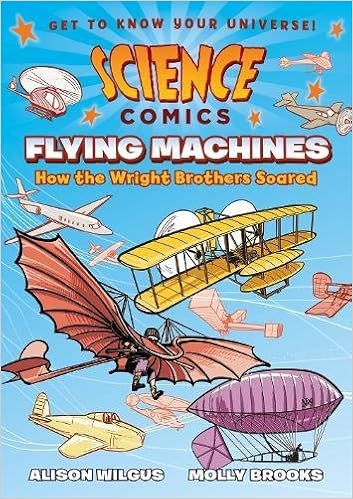
Book Review of Science Comics: Flying Machines: How the Wright Brothers Soared by Alison Wilgus and Molly Brooks

The latest installment of Science Comics, a series of non-fiction graphic novels catering to an MG reading level and audience, is Flying Machines: How the Wright Brothers Soared by Alison Wilgus and Molly Brooks. If you aren't familiar with the Science Comic series from :01, each volume features a full, information-packed narrative explanation of the titular concept, which has been reviewed by an expert in the field. After the guided tour, which reminded me of a more in-depth lesson from Miss Frizzle herself (win!), and is tailored to readers ages nine and up, the book also includes a section of notes and a bibliography for readers whose interest hasn't been quelled by just this one volume and who would like to learn more about the topic at hand.

In this volume, author Alison Wilgus introduces readers to a historical figure they may never have heard of: Orville and Wilbur Wright's younger sister Katharine. Just like many little siblings, Katharine took a great interest in the exciting project her big brothers were involved with, and was their biggest champion along the way. She was an interesting choice to serve as a narrator for the story, because many readers of Flying Machines have no doubt either been the little sibling who watched from the sidelines, or had such a brother or sister. Also, it is surprising to note that she was so integral to the Wright brothers' development of their flying machine, but that, without having read this book, I never would've heard of her. Katharine really humanized the narrative, adding in colorful commentary and emotion, and keeping Flying Machines from being simply a list of historical dates and facts. It was an effective storytelling choice, for sure!  One of my favorite parts of the book was the mini biography of Katharine Wright included near the end.

I also appreciated that Flying Machines incorporated a depiction of the race to invent a flying machine. Many kids (including me) probably grew up with the belief that the Wright brothers were the only ones working on such an invention, so I think it is important to note that, actually, several other parties were toying with similar ideas at the time. It was fun to see how they fed off of each other's concepts, and how one person's obstacles might lead to another inventor's breakthrough.

Molly Brooks' illustrations really won the day. Her drawings of planes (and other mechanisms) in flight really captured the motion of each one, so they came alive from the page. Reading Flying Machines was kind of like watching a Miyazaki film, due to her lively and imaginative drawings. I also loved the colors she selected for the settings and clothing of her characters--the warm brown and gold tones and cool blues really added to the story and set the time period in my mind. Brooks' depictions of Orville and Wilbur made them stand out in my imagination, whereas when I'd read about them previously, the brothers were somewhat interchangeable. Her characterization of Katharine was endearing and kept me interested even in parts of the story where the narrative lagged where it was held down a bit by lots of technical detail.

Coming out on May 23rd, teachers, parents, and aviation fans alike will be thrilled by this detailed, educational graphic novel history of the origins of heavier-than-air flying machines. You can preorder it now. If that isn't enough, previous titles in the series cover coral reefs, dinosaurs, volcanoes, and bats. (I really wish I'd gotten my hands on the one about dinosaurs, myself, as anyone who knows me knows my love of dinos is deep and profound!) I can really see these books being useful for science teachers or homeschool parents to build lesson plans (especially with the bibliography, glossary, and notes inclusions at the end of the texts), or as wonderful gifts for curious scientifically-minded young readers to learn independently, because of the lively dialogue and colorful illustrations. But, even as someone who isn't particularly interested in flight, and who read the book as an adult, the strong partnership of Wilgus' writing and Brooks' illustrations kept me hooked until the very last page. Highly recommended!

Friday, April 7, 2017

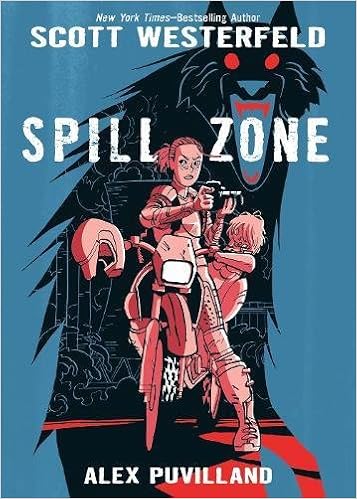
Book Review of Spill Zone by Scott Westerfeld and Alex Puvilland

Spill Zone is the first in a new series of graphic novels from :01 written by Scott Westerfield and illustrated by Alex Puvilland. They tell the story of sisters Addison and Lexa, who live in Poughkeepsie, New York three years after an event known only as "the spill," which changed things forever and unleashed unnamed and unnatural creatures within their hometown, which is now quarantined from the rest of the world. Older sister Addison enters the forbidden Spill Zone on her bike whenever possible to capture the resultant horrors on film and sell her photographs to support herself and her sister. Younger sister Lexa appears to suffer from PTSD and selective mutism due to the trauma of having witnessed the spill. Though the cover captures how badass Addison looks on her bike, camera at the ready, I feel the monster in the background is a colossal fail. (Those shown within the book are far more terrifying, and this guy on the cover is a joke by comparison.)

Aspects I enjoyed of the writing within Spill Zone are the relationship between the two sisters, how simultaneously empathetic and mysterious Lexa's character is, and how well Westerfield depicted Addison's toughness and yet set up her younger sister to be her soft spot. I also love the trope when a character routinely enters a dangerous situation and sets rules for him or herself at the beginning of a story because, as a reader, I know that the second that experienced character breaks his or her own rules is the second shit gets real, and Spill Zone is no exception!

Puvilland did something I haven't seen used effectively in graphic novels much before: he imbued the scenes within the spill zone itself with beautiful pastel colors and some bright neon tones, and illustrated those taking place outside the zone (in Addison and Lexa's home, for instance) with dark, muted, shadowy colors). In addition to showing a powerful visual contrast between the two settings and moods, this unorthodox choice also set my teeth on edge when Addison was inside the spill zone with her camera. Somehow, the bright, pretty colors in such a ghastly setting made it feel more wrong and haunted, and I found myself holding my breath until she exited, even if she encountered nothing beyond a few off-kilter rats because of the hues Puvilland used. They turned my senses to overdrive and told me to pay extra attention. Conversely, the bruise-like palette he selected for the outside-the-zone scenes felt relaxing and almost comforting by comparison--not an association a reader would typically make with maroons, greens, yellows, and grays.

However, there was one storytelling choice which played out both visually and in the narrative that aggressively did not work for me, and that's what they did with Vespertine, Lexa's possessed-looking Raggedy Anne-style doll, pictured on the cover. *Spoiler alert.* From what I understand after reading Volume 1, Addison takes Vespertine into the spill zone each time she goes at Lexa's behest, and that "recharges" the doll, who then talks, which is seemingly only able to be heard by Lexa. Vespertine's dialogue is displayed in jaggedy white text on a black background, which is extremely difficult to read at times (this added a high level of frustration to my reading experience). Also, Vespertine has a huge attitude problem, and seems to hate Addison for no discernable reason, but Lexa seems to think sending Vespertine along with Addison into the spill zone on her photo-taking trips protects her older sister somehow. This was confusing: am I supposed to think Lexa doesn't understand Vespertine seems to have it out for Addison, or am I supposed to wonder if Lexa actually has it out for Addison, as well? Either way, it did less to build intrigue than it did to mount confusion, and I felt like that was bred out of lazy writing with this aspect of the story. Also, the possessed doll trope is tired and has been done to death, so if it is going to feel new and different, it should be done better, not just be presented in a more confusing way. Confusion does not equal creepy, it equals frustrating.

Ultimately, I'd recommend Spill Zone to readers who were fans of Dark Angel, because, as I read scenes of Addison tooling around on her bike, deftly navigating a post-apocalyptic city, that's what I was reminded of. I'd also suggest it for those readers who enjoy stories of older siblings taking care of younger ones in tough times, and for people who can't get enough of nuclear accident-type narratives (like Chernobyl) and their Sci Fi counterparts. As we don't know at the conclusion of Volume 1 exactly what has caused the spill, I can't be more specific about that last category. I wouldn't recommend it for people who like possessed doll stories, because I think that entire thread of the plot was the weakest part of the whole book. For graphic novel fans who are looking for strong artwork and beautiful colors with interesting choices that really support powerful storytelling, Spill Zone is highly recommended. I'm excited to see where this series goes with its continuation in Volume 2. Volume 1 comes out May 2nd, but you can preorder it now.

Wednesday, April 5, 2017

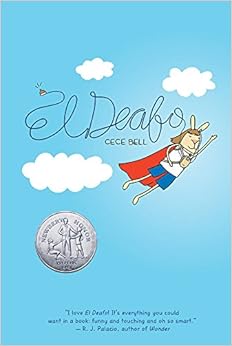
Book Review of El Deafo by Cece Bell

I wanted to read (and review) El Deafo by Cece Bell for three reasons. One is that, thanks to a crappy immune system, I've had over a hundred ear infections (and tubes three times) in my life, and I'm lucky to still be able to hear, but I never want to take that for granted. Two is that, of course, it fits right in with my mission as a Diverse Book Blogger. (Click the link in the right sidebar for more information.) And three is that sign language and Deaf culture are very important to my husband, a teacher who has some Deaf and hard-of-hearing students, has volunteered at a Deaf camp, and is trying to start an ASL club at his school currently. So, when he mentioned wanting to read this book, I figured I'd join him. His book pick was solid, and I was far from disappointed. I just love the cover. The way the characters are drawn in this book really reminds me of the Arthur books, which I really enjoyed as a kid.

El Deafo is Cece Bell's graphic novel autobiography of becoming deaf and navigating childhood afterward. A cartoonized Cece (sometimes the caped superhero version she imagines of herself, the titular El Deafo) deals with friendship drama, classroom challenges, hearing aid malfunctions, unnerving doctor's appointments, scary sleepovers, and feelings about her sudden hearing loss. If there is one basic throughline of the story, it is Cece learning to live with her deafness and figuring out who her real allies are during a difficult time of change and growth.

El Deafo could be useful to hearing kids who want to understand what Deaf or hard-of-hearing kids are going through. Bell takes the time to explain things step-by-step, such as how to speak if someone is trying to read your lips, or how to be considerate of a Deaf or hard-of-hearing friend without patronizing them or making them feel different. It could also be beneficial for adults who work with Deaf or hard-of-hearing kids, though, obviously, it is written at a MG reading level and the material is presented for that audience, because Bell also points out some of the obstacles she faced in the classroom, which teachers and other adults could've been better prepared to help with. And, though I'm not Deaf or hard-of-hearing, I wonder if it wouldn't also be great for those readers as well, especially if they are MG reading level, because they might feel sympatico with Cece when she explains how frustrating it is when hearing people don't understand some of the challenges she faces, or what a relief it can be to simply turn off her hearing aid when she wants quiet.

What's wonderful about El Deafo is Bell's emotional honesty, and the fact that she was clearly prepared to explain difficult concepts and share painful feelings for the benefit of her readers. Also, the character of Cece is so lovable that I rooted for her from the first page, and even if I'd had no interest in the subject matter, Cece's sympathetic character would've kept me reading until the end.

Saturday, March 18, 2017

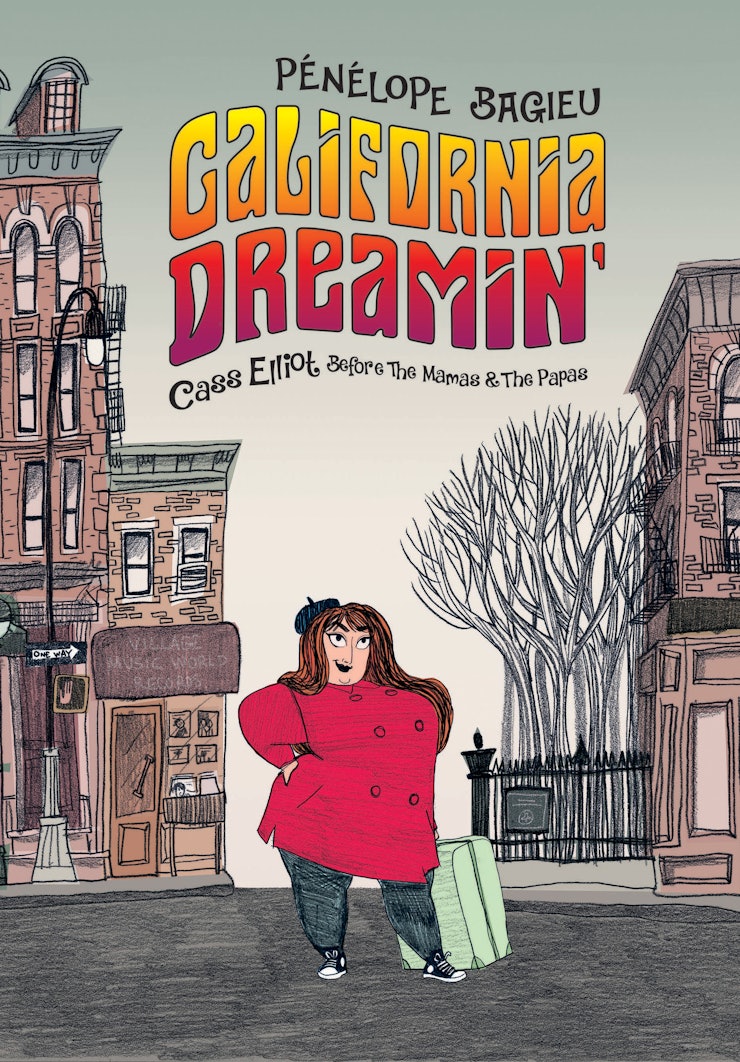
Graphic Novel Week: California Dreamin': Cass Elliot Before the Mamas & the Papas by Pénélope Bagieu


Welcome to Graphic Novel Week! This week, I will be posting reviews of graphic novels, specifically ones from :01, which is a favorite graphic novel publisher of mine. Here's a link to their website.

California Dreamin': Cass Elliot Before the Mamas & the Papas by Pénélope Bagieu is my consolation prize for being a fat, Jewish girl born too late to meet Cass Elliot. But Bagieu's strange masterpiece took me by the hand and led me through Elliot's life, and her world. Though we may never get to commiserate on the lacking availability of cute plus-size clothing, or talk about our American Jewish experiences (both things that are always fraught with emotion and conflict), reading California Dreamin' was a window into Cass Elliot's colorful life. Say what you will about her--and people have said plenty (much of it untrue)--she was truly an original. Nothing captures her essence better than the book's cover illustration, with Cass in bright red, popping off of the drab background provided by her hometown Baltimore's streets, suitcase at hand, ready for adventure. I knew I was in love with California Dreamin' the moment I saw it.

Mama Cass, born Ellen Naomi Cohen, and known to her friends as Cass Elliot, is one of those people whose legacy is part truth, part storied legend. She was the life of every party, the soul of The Mamas & The Papas, and she was always the most interesting person in the room. One of the most fascinating things about California Dreamin' is that each chapter looks at Elliot through the lens of a different person who knew her. From friends and family to co-workers and bandmates, Cass was somebody unique to everyone she met. By providing her readers with such a variety of viewpoints on the same person, Bagieu was able to paint a comprehensive picture. I closed the book feeling as though I had a firm understanding of who Cass Elliot was and what she was about. But this storytelling technique of Bagieu's also made a powerful point: Cass Elliot was mostly comprised of peoples' conceptions of her. If you knew her, you added part of her identity to the mix with your own interpretation of who she was, and who you thought she should be. Very few (if any) people who knew her managed to imagine her complexly. It was their loss, and hers.

There are many sad truths which come to light in California Dreamin'. Bagieu doesn't shy away from the harsh realities of Elliot's life. Was Cass Elliot hopelessly in love with her male bandmate, or did she just feel the need to gain approval from a man deemed attractive and successful by the masses? California Dreamin' points out something many people don't know: that The Mamas and The Papas needed Cass Elliot to succeed--she didn't need them (she only thought she did). In an age much like today, when music was sold as much on the physical appearance of the artist who creates it as the music they made, a fat girl who didn't fit society's beauty standard was at a disadvantage, no matter how talented she was. Elliot seems to have internalized those messages, constantly selling herself short and making compromises when she could've easily been writing her own ticket with her ferocious talent. For members of the body acceptance movement that could've turned Elliot's life around and worldview upside-down, it is a painful revelation. But, for all her struggles, Cass fought every uphill battle with a smile on her face and a joke coming out of her mouth. (Though, unfortunately, she was frequently the butt of said joke.)

As a reader, I found Bagieu's drawing style bizarre and unsettling, but the way she seemed to follow no rules felt natural for her subject matter. Bagieu's renderings of Elliot in particular are oozing with personality that seems to leap off of the page, as it should. Everyone else portrayed in California Dreamin' feels a little bit more subdued and in the background. From everything I know about Bagieu's subject, this feels right, and perhaps it echoes what it would have been like in the presence of the great Cass Elliot. Here's a link to an article about California Dreamin' and why Bagieu chose to write a graphic novel about Cass Elliot.

There's a playlist Bagieu included at the end of the book, featuring her favorite songs by The Mamas & The Papas and Cass Elliot. In addition to being a great introduction for those readers who may not be familiar, watching the videos on YouTube will be a fond walk down memory lane for those who recall firsthand when the music was originally released. Either way, the best part about the inclusion of such a list is Bagieu's own notes on each song, giving it context within the story of Elliot's life and work. I received a free copy of this book from the publisher in exchange for my honest review. This is easily one of the best graphic novels I have ever read.


Friday, March 17, 2017

Graphic Novel Week: Awkward by Svetlana Chmakova: A Book Review

Welcome to Graphic Novel Week! This is a non :01 graphic novel, but I recently dug up this vintage review of mine, and I wanted to bring it out again for graphic novel week because Svetlana Chmakova is one of my favorite graphic novel artists/illustrators, and she has a new book coming out in May, called Brave.

I discovered this book by accident during a bookstore run, and I'm THRILLED that I did, because I absolutely adore Svetlana Chmakova's Dramacon manga miniseries. (Sidebar: the hubs and I were tight with a group of manga/anime fans in undergrad. We were kind of on the fringes of the group, but somehow got roped into going to an Anime Convention, which was excellent, btw, so I really identified with the whole portrayal of the convention in Dramacon.) I really enjoy the cover design, because the body language of the two characters in the foreground totally conveys awkwardness!

I love that the protagonist, Peppi, (pictured on the left side of the cover) breaks all of her personal rules for social success as the new girl in school, but still manages to triumph at the end. Though she and Jaime (right) get off to a rocky start and have different interests: art--Peppi, science--Jaime, I really enjoyed how they built not just a friendship over the course of the book, but a partnership between archrival school clubs (art and science). Sidenote: I didn't realize school clubs HAD archrivals within their own schools. Who knew?

The colors are lovely and muted. The characters are personable and falliable. The plot is quick-paced and exciting. Everything about this manga is quirky and enjoyable. I highly recommend it, especially for middle schoolers who have a strong interest in art or science, or those who are nervous about encountering a new school.

Thursday, March 16, 2017

Graphic Novel Week: Secret Coders: Secrets & Sequences by Gene Luen Yang & Mike Holmes

Welcome to Graphic Novel Week! This week, I will be posting reviews of graphic novels, specifically ones from :01, which is a favorite graphic novel publisher of mine. Here's a link to their website.

So, Secret Coders: Secrets & Sequences by Gene Luen Yang & Mike Holmes is the third book in the Secret Coders series of MG graphic novels. The first volume (Get With The Program) was awesome! (Scroll down two reviews to read about it.) The second one (Paths & Portals, review is just below this one) had some issues and felt more like a cartoonized computer programming workbook. With one hit and one miss already in the series, I wondered if Yang and Holmes would be able to capture the magic of volume one, or if they were doomed to repeat the mistakes of volume two in the third installment of the series. I requested a free copy of this book in exchange for my honest review to find out. While #3 feels much more like the story-driven #1 instead of the workbook-esque #2, I am still not a fan of these cover concepts. However, that is one of my few complaints.


Luckily for readers, Secrets & Sequences delves more deeply into the mysterious conflict happening at the Bee School. Hopper continues to try and solve the riddle of her father's disappearance, and she and her friends do their best to outwit the diabolical Dr. One-Zero. 

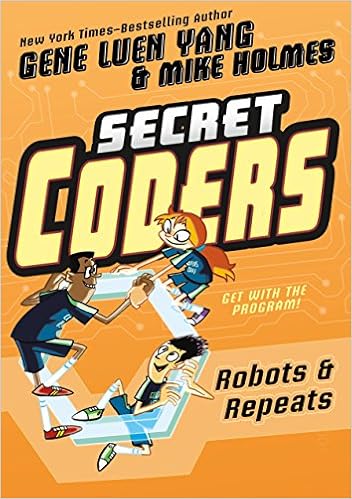
One of the best aspects of this book is that it shows how understanding computer coding gives the kids agency and illustrates that these skills enable them to fight back against injustice or feelings of powerlessness--a timely message in today's world. The story has a great balance of action and character development, and there's plenty of coding still happening, including a few mini lessons where kids (or, really any readers) who are reading along and want to learn computer coding can stop and work out the problems for themselves. But, because Secrets & Sequences is so much more character and plot-driven than its predecessor, it never feels like a workbook. This is a win, and it makes me excited for the release of volume four: Robots & Repeats, which is due to hit shelves on October 3rd. I will be reviewing it later this year, but here's a peek at the cover:


Graphic Novel Week: Secret Coders: Paths & Portals by Gene Luen Yang & Mike Holmes

Welcome to Graphic Novel Week! This week, I will be posting reviews of graphic novels, specifically ones from :01, which is a favorite graphic novel publisher of mine. Here's a link to their website.

Since the first graphic novel in this series (Secret Coders: Get With The Program) knocked my socks off (see the review just before this one), I requested a free copy of the second book from the publisher in exchange for my honest review. The things I liked about book one were the well-developed characters, the playful attitude of the story, and the amazing way it demonstrated binary visually so that I could understand the concept. Unfortunately, Book Two (Paths & Portals) does not share many of these positive qualities. However, it does have its own strengths to add to the mix.

In Paths & Portals, it seems that the true mission of this graphic novel series has been revealed. What felt like a fun foray into computer programming designed to get kids interested in the field now feels like a cartoonized computer programming workbook. Instead of a graphic novel adults could also enjoy, book two had almost no entertainment value for readers who might not want to work alongside the kids in the story to do the computer programming exercises. While I can see how Paths & Portals would have tremendous value within a STEM classroom setting, or even as fun reading for a kid with a burgeoning interest in computer programming, shifting the focus from a mystery involving programming to actual repetitive-seeming computer programming exercises reduced character development and all but stopped the progression of the story in its tracks, and replaced those necessary elements with what felt like little more than a workbook.

I finished book one feeling excited and eagerly anticipating the next volume in the story. But, since reading book two, I wonder how much story will actually be told in the subsequent volume. Using graphic novels to teach computer programming and get kids interested in the field is great, but I wonder how effective the strategy is when it comes at the expense of action, plot, and character. Will these issues be solved in volume three? My review of Secrets & Sequences will be up later tonight. Stay tuned!

Graphic Novel Week: Secret Coders: Get With The Program! by Gene Luen Yang & Mike Holmes


Welcome to Graphic Novel Week! This week, I will be posting reviews of graphic novels, specifically ones from :01, which is a favorite graphic novel publisher of mine. Here's a link to their website.

Secret Coders: Get With The Program! by Gene Luen Yang & Mike Holmes is one of the most amazing graphic novels I've encountered (at least for kids), because it managed to explain binary code in a way that I could understand, and even found fun! Despite the front cover illustration (which I found moderately off-putting, I must say), I found the back cover illustration simply marvelous and the back cover text intriguing.

Then, I opened the book, and my adventure began. The whole volume clocks in at just under 100 pages, which, in graphic novel terms, means it translated into about a 20-minute time commitment for me. I was drawn into the story immediately, as I usually cannot resist the tale of a young girl becoming acquainted with her new surroundings right after being forced to move to a new town by her parents (see: Spirited Away, Nightmare, and many other perennial favorites), and I was along for the ride as Hopper confronts her new school, and all that it has to offer.

From there, I was dragged along as Hopper and her new potential enemy-turned-friend, Eni, follow a robotic turtle down the rabbit hole in an exhilarating chase through their school grounds to find out just why the birds populating their campus are so creepy, who is posting numbers all over the walls, how to use computer coding to get robots to do their bidding, and what is wrong with all of the adults at their school. (No, seriously... more than normal; something's really wrong here!) In the ultimate cliffhanger ending, book one finishes way too early in the plot to leave readers anything but salivating for book two, Secret Coders: Paths & Portals.

Though it may not be super important, I do appreciate that the book is printed in black, white, and green (instead of greyscale), in what I can only assume is a witty homage to ancient computer screen displays! It took me right back to the olden days of C:Batch files of yore! Am I right, older readers?

If you're an adult who likes mysteries and or computer coding, or you want a book for a middle schooler (or perhaps even a high schooler) with those interests, I don't think you could go wrong with this one! I highly recommend it as an entertaining and educational read. I received a free copy of this book from the publisher in exchange for my honest review.

Graphic Novel Week: The Time Museum by Matthew Loux

Welcome to Graphic Novel Week! This week, I will be posting reviews of graphic novels, specifically ones from :01, which is a favorite graphic novel publisher of mine. Here's a link to their website.

For those of you who have been following along with graphic novel week, you may have noticed that the first three reviews were of books for teens and adults. However, The Time Museum, by Matthew Loux, is the first volume in a middle grade series about Delia, a science nerd character with lots of agency. I strongly dislike the cover, because I felt having all of the characters look down at their wrists or at the ground and not being able to see anything but the building shut me out of the scene as the viewer. I also disliked that the girl one in from the left in the blue headband looked so much like the girl who was front and center (before reading it, I presumed that was Delia, the protagonist), and I wondered if they were both supposed to be her in different times, or if there were just two characters who looked so similar to one another. Either way, it was confusing and did a poor job of setting the mood or scene for me. Also, it didn't do well at showcasing the vibrant colors which come alive within the book.

Delia, a smart, awkward girl, knows she'll be visiting her Uncle Lyndon over the summer, but she doesn't know he works at a museum with exhibits from all eras of time, and portals to those eras. Delia also doesn't know that she has the chance to compete in a contest for an internship position within the museum, and she'll have to travel back and forth through time to complete the challenges, besting five other kids--competitors from different time periods. 

I really had trouble buying in to this story. The whole setup felt too stilted and contrived. The commentary as the kids wander through the museum didn't feel natural to me, at all. I felt Delia had honest emotional responses to whatever situation she was in, but I really wished I'd been able to read more scenes of quiet conversations with just her and her roommate to better understand both characters and observe their dynamic in a quiet setting before things got crazy. As the book progressed, I felt like there was too much action and chaos, and not enough character building and development to keep me interested. I longed for the characters to have more personal connections with the historical exhibits they were experiencing, instead of just clowning around. The colors were beautiful and the glossy pages decadent, but the art style really grated on me the more I read. All in all, I only finished the book because I was reviewing it, and I wouldn't pick up the second volume. I don't recommend this one.

(As a point of comparison, other middle grade graphic novels I have liked are the Secret Coders series, Awkward by Svetlana Chmakova, the Bone series by Jeff Smith and El Deafo--reviews to come.) I received a free copy of this book from the publisher in exchange for my honest review.

Wednesday, March 15, 2017

Graphic Novel Week: Decelerate Blue by Adam Rapp and Mike Cavallaro


Welcome to Graphic Novel Week! This week, I will be posting reviews of graphic novels, specifically ones from :01, which is a favorite graphic novel publisher of mine. Here's a link to their website.

Decelerate Blue by Adam Rapp and Mike Cavallaro is a thoughtful graphic novel about what it means to resist change for the sake of change, speed for the sake of speed, and "improvement" that might not be better than what predated it. The cover is an absolutely gorgeous palette of blue hues, which definitely accurately describes the style and mood of the book.

Decelerate Blue reads like The Giver meets In Time. In a world where speed and brevity reign above all else, Angela feels like a misfit. ...little does she know there's a (literal) underground resistance going on, where people do more than just stop and smell the roses. With overprotective parents who are deeply entrenched in their society's flawed ideals, Angela's quest to be accepted and understood in a place where she can take time to examine her reality is risky. But, not taking the chance to experience life as it was meant to be lived, with time for contemplation, is also taking a gamble. Given the chance to step back from modern society's relentless messages about who she should be and what she should do gives Angela the opportunity to find out who she really is, and what is worth risking for it.

The style of Cavallaro's art is powerful, with many bold expanses of black on the page. Shards of white space slice through the darkness, using stark contrast to dramatic effect. With colored page edges being so trendy in publishing right now, it is worth noting that, fittingly, the edges of Decelerate Blue's pages are a beautiful shade of blue, which is unnoticeable when looking at one individually, but they combine into a lovely mass when the book is closed.

Rapp's story is very timely. Kick the Boot--the fictional manifesto of the slow living alternative Angela discovers--is possibly the 1984 of her day. In today's political climate, this is a relevant and important graphic novel. Activism, social justice, and marginalization are all topics swirling around in our collective consciousness, and are used as elements of the story to great effect. 

On a more personal level, once Angela realizes what she wants, she must struggle with the idea that not everyone she is close to shares her values. Similarly, there are many people who have begun to realize that their friends or family may have startlingly different beliefs (ones they may even find offensive), and are grappling with questions of how to continue relationships with those they care about in light of such differences, or how to accept that they should be severed in order to preserve what is most important to them as individuals. If any of this has been on your mind, check out Decelerate Blue. It may help you process the overwhelming state of current events while simultaneously providing the escape of doing so while spending time in a fictional world. I received a free copy of this book from the publisher in exchange for my honest review.

Tuesday, March 14, 2017

Graphic Novel Week: Demon Vol. 2 by Jason Shiga


Welcome to Graphic Novel Week! This week, I will be posting reviews of graphic novels, specifically ones from :01, which is a favorite graphic novel publisher of mine. Here's a link to their website.

The dedication of Demon Vol. 2 by Jason Shiga is as entertaining as that of the first. "To my wife, Alina, who's still mad at me for dedicating the first volume to her." Having read the first volume, I laughed when I saw this, and thought, "Well, that's fair." But still, I paged beyond the dedication to find out what else lay in store for former actuary (current demon) Jimmy. But first, I had to stop and appreciate the appropriateness of the cover art for what lay beyond. If the cover for Vol. 1 served as a warning, the cover for Vol. 2 serves as a tribute. As you can see, demon Jimmy simply can't behave peaceably.

Still reeling from the big reveal in Vol. 1 that *spoiler for Vol. 1* Jimmy's wife and daughter were killed by a drunk driver, and Jimmy's mission is to exact his revenge upon him, I was distracted from the artfulness of that by one thing--the most disgusting prison break I have ever encountered in fiction. Also, I am giving Shiga the side-eye pretty hard because... how does he know that would work? Did he actually test it out? I do not want to know. 

But, back to Jimmy's tragic past! This is another illustration of Shiga's brilliance, because just when he makes the reader think Jimmy is nothing but a disgusting, violent, selfish mess of a person demon, then he reveals that some drunk schmuck thoughtlessly killed Jimmy's wife and daughter by getting behind the wheel after already having DUIs on his record. Jimmy's demon side (the emotional one, at least) now has an origin story. That begs the question: who is really the monster here: Jimmy, or the driver? As foul and disturbing as Jimmy's actions are, somehow they don't bother me as much as the drunk driver's choices that led to Jimmy's family being killed. Shiga has managed to do the almost impossible--create a supremely unlikable protagonist who is an empathetic character. That, combined with all of the satisfyingly surprising plot twists and intrigue Shiga develops surrounding the government agents pursuing Jimmy are what will keep dubious readers' eyes glued to the page through every last gory panel. I'm sure those readers will be comforted to know that Demon Vol. 3 comes out July 18th, and curious about its dedication page. I received a free copy of this book from the publisher in exchange for my honest review.


Monday, March 13, 2017

Graphic Novel Week: Demon Vol. 1 by Jason Shiga

Welcome to Graphic Novel Week! This week, I will be posting reviews of graphic novels, specifically ones from :01, which is a favorite graphic novel publisher of mine. Here's a link to their website.

The dedication of Demon Vol. 1 by Jason Shiga should serve as a warning. In a similar style to "Abandon hope, all ye who enter here," it reads, "To my wife, Alina, who begged me not to dedicate this book to her." That's when I knew I had to read this book, to find out why. And, after experiencing all that is Demon, I can honestly say that I understand. ...but that doesn't mean you shouldn't read it. It just means that Jason Shiga has managed to create a golem of a graphic novel by combining the most depraved aspects of Sin City with the general zeitgeist of the movie Super, which my husband tricked me into seeing by telling me "that guy from Gilmore girls is in it." If Demon had a narrator, it would be Stuart from Family Guy. But, if you couldn't tell something's up from the maimed takeoff of a Dilbert cartoon featured on the cover, well, I can't really help you.

When actuary Jimmy commits suicide and awakens moments later (repeatedly), he discovers that he is not just a normal guy, after all. With an axe to grind and an inability to die, Jimmy leaves hundreds of bodies in his wake. His missions? To figure out what's going on and stay free of the special intelligence team tasked with pursuing him. This sounds slightly more exciting than then 9-5 grind of the actuarial office where Jimmy has spent a large percentage (he's such a mathematical genius that he could probably say exactly what percentage) up until this point. ...but, what drove Jimmy to suicide in the first place? You'll have to check out Demon yourself to find out. You can preview Demon Vol. 1 here.

The unique thing about Demon isn't Shiga's complete lack of boundaries, or the absence of decency (though, check and check), it's the fact that, despite how shockingly gross, violent, disturbing, sexual, and morally abhorrent aspects of the story are, there's a deeper engine beneath all of that which kept me reading. (Through fingers over my eyes, but still.) Every time I threw up in my mouth a little and wanted to put the book down, something else reeled me back in. 

That something is Shiga's utter brilliance. He is logical, wickedly intelligent in the best way possible, and an abstract enough cartoonist that the disgusting things depicted within his work are worse in my mind than they are on the page. ...which is kind of the point, isn't it? Shiga has buried a boggart deep within Demon, and it is that the truly unfathomably deplorable person isn't Shiga, and it isn't Jimmy, it's the reader, because nothing is going to be as horrifying as what your mind tailors specifically to your own sensibilities. You know way better than Shiga could ever know exactly what disgusts you, and his genius is that he understands that, and doesn't even try to compete with it, but instead capitalizes on it. 

I received a copy of Demon Vol. 1 free from the publisher for the purposes of this review, which contains my honest opinions.