Monday, May 8, 2017

Book Review of Antisocial by Jillian Blake

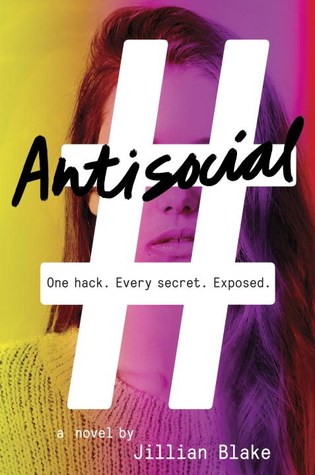
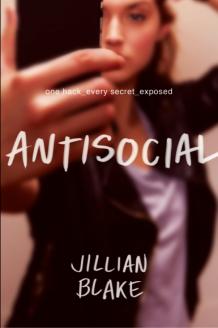
Antisocial by Jillian Blake is another ARC I received from the First In Line VIP program of an upcoming YA release (May 16th), which, like One Of Us Is Lying, is a mystery/suspense story that prominently features misuse of technology in a high school setting. They also have similar covers--in this case, it is a single girl's face that's obscured. The girl is Anna, Antisocial's protagonist. Though I like the rainbow effect of the cover background, I can't decide which I find more distracting: the hashtag slashing through Anna's face, or the fact that the girl who is supposed to depict Anna (a character of Colombian descent, who is frequently compared to Sofia Vergara in appearance), but I can tell you which one upsets me.

While covering Anna's eyes is an artistic choice, misrepresenting her as a white girl is a racist one made by marketing department employees who decided a white girl would sell more books. This crap happens all the time in YA (and publishing in general). I can't say how Jillian Blake feels about this issue, but I can say that, if I'd gone to all of the trouble she did to include details about how guys think calling Anna South American while hitting on her will get them points, and how people who aren't Colombian seem to believe all people of Colombian descent look the same and then my publisher slapped a white girl on the front of my book instead of one who actually resembled my protagonist of Colombian descent, well, I'd be pissed.

By the way, The US cover is on the left, and the UK cover is on the right. I guess the marketing department thinks YA readers in the UK are less racist? I addition to the US cover being a diversity representation fail and yet another victim of whitewashing, the UK cover also depicts an actual plot point from the book, as well as conveying the mood of the story much more effectively than the US cover.
Anna is returning to school after Winter Break of her Senior Year--a break during which her longtime boyfriend dumped her without explanation. Suddenly, the social life she built around her dating relationship crumbles, and her Social Anxiety Disorder rears its ugly head. While Anna was busy trying to fit in with the ultra popular crowd where her boyfriend's buddies sat during lunch, she neglected and betrayed her actual friends. Upon her return to school, she finds herself boyfriendless, friendless, and drowning in a sea of anxiety-related symptoms. This isn't the best position to be in under normal circumstances, but then kids' phones start getting hacked around school, and their darkest secrets are revealed. The popular students (friends of Anna's ex) are the targets, and nobody can figure out who the hacker might be, because so many different kids stand to gain from unseating the popular kids from their thrones. Everyone has something to hide, and to lose... including Anna.

While Blake's representation of someone with Social Anxiety Disorder was solid, I found it super distracting that she constantly referred to it as SAD. I've always known SAD to stand for Seasonal Affective Disorder, so I kept having to stop and remind myself that isn't what Blake was talking about when the acronym appeared, which took me out of the story again and again. This is a small detail that made a big difference in my reading experience (for the negative). If Blake was looking for a shorter or less clunky way to refer to Anna's Social Anxiety Disorder, I wish she would've just said anxiety. Since Blake carefully described Anna's diagnosis and symptoms early on, I don't think using a general term like that would've taken away from the story like using SAD did. 

Speaking of Social Anxiety Disorder, Antisocial begins slowly, with an opening that feels like it was ripped out of one of those middle school speeches starting with a dictionary definition of a word. The whole first chapter felt like a backstory and information dump, making it difficult to get into the story and develop empathy for the characters or anticipation about the mystery plot. Unfortunately, the whole book failed to build the excitement it should have. As the story progressed, my interest decreased with every chapter. If I wasn't writing a review, I would've put the book down well before the halfway mark and not picked it back up. 

Since Antisocial deals with cell phones, hacking, and quite a bit of social media, there are lots of little excerpts and quoted sections from those sources. However, the way they're presented is frustrating an annoying, rather than creative and amusing, so I found myself wanting to skip them, even though I knew they could contain important clues as to the hacker's identity. Some of the characters (even the secondary characters) were well-written, but there were far too many to keep track of, and there were several kids (at the lunch table, for example), who didn't need to be named and described as if the reader was supposed to remember who they were, because they hardly factored in later, if at all. 

Ultimately, Antisocial suffers from a slow-to-develop plot that feels boring, clunky inclusion of social media, and a whitewashed cover. It had every opportunity to get me interested, and it fell flat each time. If you're looking for a new YA release with elements of mystery and suspense that involves lots of technology, check out One Of Us Is Lying. Antisocial is definitely one to skip.

Saturday, May 6, 2017

Book Review of One Of Us Is Lying by Karen M. McManus

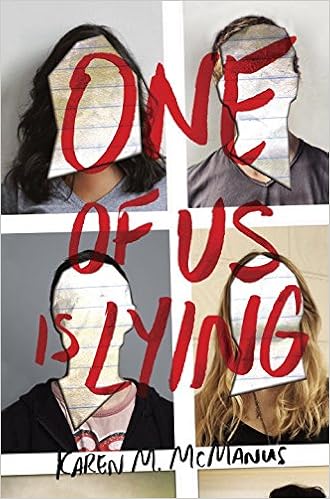
One Of Us Is Lying by Karen M. McManus is an ARC I received from the First In Line VIP program. I was excited to read it as soon as I heard the story compared to The Breakfast Club, Gossip Girl, and PLL. Though I'm not sure I agree with all of those comparisons--it certainly doesn't have the wit or self-awareness of Gossip Girl, or the level of highly-stylized suspense of PLL--I will say that there's plenty to recommend this intricately-plotted novel. ...perhaps nothing more than the fact that this line from the cover is completely true, "Pay close attention and you might solve this." I will say that I'd describe it as Death Joins The Breakfast Club. There were some points where the pacing lagged, and others where things didn't make sense because a question was asked in dialogue right after it was answered in action or narration. But, for all of McManus' shortfalls, she does engage in one of the most difficult things a mystery and suspense writer can achieve: she delivers 100% on the cover's promise of fair play while spinning a compelling yarn.

Speaking of the cover, while I like the general idea for the concept, I hate the (pardon the pun) execution of it. Bronwyn is supposed to be half Colombian, and she looks just like any other white girl with dark hair, which is a super frustrating example of yet again even more cover whitewashing in YA specifically (and publishing, in general). I wonder how McManus feels about such a design choice, considering all of the ultra-aware content she included in the book regarding Bronwyn's racial background and ignorant reactions of people she encounters. As an important sidenote, I was quite impressed with the way Bronwyn's character was written with regard to race. McManus dealt simply with issues of racism and ignorance, and used a light touch while still sending a strong message that these behaviors aren't okay.

Also, the book constantly refers to how perfect Addy's hair is, and its stringy, disheveled appearance bothers me here because it doesn't fit with that description. I think having the suspects' faces covered with notebook paper cutouts is more distracting than it is provocative or chilling (or whatever the cover design team was going for here). And I would've liked to see Simon's picture on the cover as well, especially since he was included in the list of five characters on the back.

The premise of One Of Us Is Lying is simple: five kids (Bronwyn the brain, Addy the beauty, Nate the criminal, Cooper the athlete, and Simon the outcast) are sent to detention after mysterious (and forbidden) burner cells are found in their backpacks during school. While in detention with a Luddite Science teacher who notoriously despises technology, Simon helps himself to a drink of water, and then drops dead. Because Simon maintains an app curating and disseminating the latest gossip about his fellow students, each of the other students has a motive for wanting him dead. The four other students quickly become suspects, and the rest of the book unfolds as they react to Simon's death, and to the investigation regarding who might have caused it, and why.

As regular readers of my blog will probably recall, I'm notorious for guessing the endings of books, and this was no exception. However, McManus did have me hedging my bets with two suspects for the first third of the story. Still, the fact that I was able to accurately guess who killed Simon means that McManus (for all of the plot twists and turns, and red herrings she included... and there were many), played fair, and I also doubt that the ending would be easy for other readers to predict.

Simon was found to have died from exposure to peanut oil, as he had a severe anaphylactic allergy to peanuts. As someone who has several anaphylactic allergies and has to carry EPI pens everywhere, I appreciated the realism with which McManus included details about this plot point. (So often, when authors include a plot point about a medical problem I share, I'm distracted because they got the details blatantly wrong!) For example, she accounted for the EPI pens in Simon's bag and in the Nurse's office. She also explained the type of peanut oil that would've had to have been in Simon's water, and how someone would know what kind to use. Obviously, though, since Simon's death is the inciting incident for the book, readers don't get to see much about his allergies from his perspective.

Speaking of perspective, one of the most interesting things about One Of Us Is Lying was the narrative style. The narration rotated amongst Bronwyn, Addy, Nate, and Cooper, giving readers four pleasingly unique perspectives on the story, and allowing for more clues to be dropped without being obvious or absurd.

One Of Us Is Lying by Karen M. McManus comes out May 30th, and is currently available for preorder. Though I recommend this book to those who love to read mysteries and play along in an attempt to solve them, I caution book buyers that this is a story they may only find enjoyable once, so borrowing it from the library may be a wiser choice than making a purchase in this case.

Wednesday, May 3, 2017

Book Review of 10 Things I Can See From Here by Carrie Mac

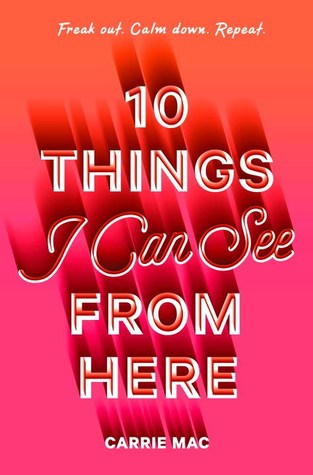
As a longtime participant of the Blogging for Books program and a YA enthusiast, I was thrilled when they announced that they'd be offering new YA titles. 10 Things I Can See From Here by Carrie Mac is the first such title of which I requested a free copy for the purposes of review. Though I've suffered from anxiety for several years, I've only recently been diagnosed with an Anxiety Disorder, and I chose this selection because the protagonist, Maeve, lives a life ruled by anxiety. I'd never heard of Carrie Mac, so I wanted to see how she dealt with the issue of Mental Health, and what her writing was like in general. I was curious despite the boring and highly off-putting cover design. I truly hate the cover.

Maeve is a sixteen-year-old Lesbian with divorced parents and a severe Anxiety Disorder. When her mom travels abroad for six months, Maeve lives with her dad, pregnant stepmom, and two younger stepbrothers. Her dad struggles with Alcoholism, and her stepmom couldn't be more opposite of the evil stepmother trope. As Maeve meets Salix, a violinist she's interested in and things heat up, they're also building as her stepmom's pregnancy progresses, Maeve's anxiety levels increase, she loses a friend in a very traumatic way, and her dad turns his live over to alcohol once more.

One of the most frustrating things about 10 Things I Can See From Here is that practically every character except Maeve is more well-developed and three dimensional than Maeve herself. Mac seems to confuse constant descriptions of and reminders about Maeve's Anxiety Disorder with character building for Maeve. Though Mac does a great job showing readers who may not be familiar with such things how anxiety and an anxiety attack might manifest, she does a lousy job showing readers who Maeve is, anxiety aside. Thus, the unfortunate underlying message in this book is simple: people with severe Anxiety Disorders are solely comprised of their illness. This is wrong. It is also insulting.

"But, Maeve likes to sketch," you might say. Sure, she does. she sketches as a coping mechanism to deal with her anxiety when she feels it coming on. She doesn't seem to sketch for fun, or out of a particular interest in art. "But, Maeve likes to recite statistics," you might say. Sure, she does, she recites statistics she has memorized about things she has anxiety about, so this is yet another "interest" that is really just connected with her disorder. "But, Maeve likes to make up fake obituaries in her head," you might say. Sure, she does, she makes up fake obituaries in her head because she's imagining the worst case scenario of what might happen if the thing she has anxiety about currently goes as wrong as it can go, and then compiles a fake obituary based upon that scenario for herself, or for someone else involved. So, does Maeve have any interests that are actually hers, and not based in her anxiety? Not according to Carrie Mac.

Another problem I had with 10 Things I Can See From Here can be summed up by the last sentence of jacket copy, talking about Maeve. "Will she be able to find focus through all the chaos to be there for the people she loves?"  In other words, Maeve doesn't deserve to be happy and mentally healthy of her own accord, or for her own well being--she should only strive to keep her Anxiety Disorder in check to fill the roles of daughter, stepdaughter, stepsister, friend, and girlfriend. That is a pretty damaging message to be sending YA readers of a book wherein the protagonist struggles with mental illness, especially about a teenage girl--a demographic who is already pressured by various parts of our society to say "yes" to social demands from every angle and adopt a people-pleasing personality that can be detrimental to mental well being.

Lastly, *spoiler alert* there's a scene very late in the book when Maeve confides in Salix that she was sexually assaulted. Maeve has attempted to maintain a penpal-type of relationship with the girl who sexually assaulted her, and her assailant has apologized to her for the assault. It is unclear if Mac is trying to say that Maeve's severe Anxiety Disorder is a result of her sexual assault, but the way it is dropped in, almost as if it is an afterthought, near the end of the book didn't work at all. There was no foreshadowing that prepared readers for the big reveal of this information. There is no helpful and clear unpacking of these issues during the denouement of the book. It is simply thrown out there, briefly discussed, and then swept back under the rug to get to the happy resolution of the story. As a reader, I find that to be a disturbing way to deal with sexual assault. As an adult reviewing a YA book, I wonder what the negative impact of this type of inclusion might be on teenagers who read 10 Things I Can See From Here. Carrie Mac basically chose to drop sexual assault in as a plot point and did it in the laziest way possible, writing-wise. Here's a link to an old blog article (but still a very relevant one) that explains more about why this is a problem.

In conclusion, I really don't recommend this book to anyone. I find its portrayal of Anxiety Disorders and its handling of sexual assault to be potentially damaging. I think the writing is lazy and the protagonist is shown as being no more than her disorder. To me, this book was a total fail.

Tuesday, May 2, 2017

Book Review of The Last Good Girl by Allison Leotta

I checked out The Last Good Girl by Allison Leotta from the library to read and review on the suggestion of a friend who knew I enjoyed books by Kimberly McCreight and noted their similarities. After finishing the book, I can definitely say it was an apt comparison. The book doesn't look like much, though. The cover is possibly the biggest letdown about the whole publication. Though it has imagery that makes sense with the story, the whole style is too soft and picturesque for the gruesome, gritty tale held within its pages.

Unfortunately, while this particular tale is based in fiction, readers need look no further than the nearest college campus for evidence that the themes Leotta included are all too relevant. Fraternity abuse of privilege, sexual assault on college campuses, policies that put assault victims on trial more than their attackers, Title IX enforcement that is lax or nonexistent, fundraising politics overshadowing ethical obligations, class disparities, and female students allowed to be intimidated when they attempt to speak out about their terrifying experiences are all factors of the modern college landscape.

Leotta addresses these issues deftly and with purpose in telling the story of Emily, a missing college Freshman who was last seen leaving a bar while pursued by Dylan, a fraternity brother from her campus whom she had accused of sexual assault. As the search for Emily (or, potentially, her body) escalates in the blighted Detroit area just outside of the verdant college campus where the alleged assault took place, the amount of impropriety, intimidation, and other abuses discovered in conjunction with the investigation is staggering. And, still, no Emily. 

One of the things I liked about this book, aside from the timeliness and the importance of the issues Leotta included, is that the plot kept me guessing. I didn't figure out the ending until there were mere chapters left to go--a feat for Leotta, considering that I find most suspense/thriller/mystery books frustrating in their predictability. 

I didn't much care for protagonist Anna Curtis, the prosecutor who is leading the search for Emily. I felt Leotta included an overwhelming and unneeded amount of detail about Curtis in an attempt to flesh out the book. I would've liked more scenes showing students reacting to Emily's vlogs once they went live, or other similar inclusions that would've added to the main plot of Emily's disappearance and other students' reactions to it, instead. I didn't find Anna to be a particularly empathetic character, and I got bored of reading about her struggle in choosing between the two men who are interested in her, and the two cities where she could live. If forced to read more about Anna at all, in order to unravel what happened to Emily, I would've liked to read more about Anna's relationship with her sister Jody, as I felt it meshed better with the look at sisterhood and female activism themes in the story, especially later when Jody became involved in the investigation.

All in all, The Last Good Girl was hit-or-miss for me. The suspense plot was riveting and relevant, but the protagonist was boring and eye roll-inducing. If the current issues and well-plotted mystery thread are enough to keep you reading, I'd recommend it, but if you require a protagonist you can really root for to lead such an investigation, The Last Good Girl by Alliston Leotta is one to skip.

Monday, May 1, 2017

Book Review of You Will Know Me by Megan Abbott

I put You Will Know Me by Megan Abbott on hold at the library after learning about it via Shelf Awareness. What I read about it in that newsletter made me wonder if it would turn out to be like Make It Or Break It-goes-to-the-dark-side. It was, and I was far from disappointed. The cover, however, is a different story. Also, the title left much to be desired, in my opinion. After truly enjoying the book, I'm baffled at the cover art and title choice, as they feel completely unrelated to the story.

You Will Know Me gives readers a look into a strange world, the secret machinations of which they'd never otherwise be privy to, and that world is US Elite Women's Gymnastics. That title may be a bit deceptive, because, by  the title of "women," you might think they're adults. Nope. The gymnast in question in this story is Olympic hopeful Devon and, though there are some plot inconsistencies regarding her age, she is purported to be 15. She spends at least 30 hours in the gym per week, and her parents have a second mortgage on their house just to fund her Olympic dreams. She does not go on dates, indulge in sleepovers, chill, hang out, have an after school job, or a hobby, or do anything else that most teenagers do. Devon lives her life in pursuit of one goal, and everything she does (and her family does, by extension), is in service of it.

Unlike many families wherein such single-mindedness on the verge of seeming insanity is at play, it is Devon--not her parents--who has chosen this life for herself, and whose drive pushes them all forward. From the other girls at the gym to her coach, from her parents to her little brother, to the other gym parents, everyone in Devon's orbit operates to serve the goal of Devon competing in the Olympics. That, in and of itself, is both awe and horror-inducing... but then, when Abbott forces readers to confront the question of what those within Devon's insular world would do to protect and ensure that Olympic dream, a whole other level of horror sets in.

Abbott has selected Devon's mother, Katie, as the protagonist of the story. After finishing the book, I'm not so sure this was the best choice. I would've much preferred to hear the story unfold as from Devon's younger brother Drew's perspective. I think that would have both underscored the level of terror and also balanced the question of reality vs. hallucination/fantasy/nightmare nicely, as adults frequently disbelieve Drew throughout the story about things he has observed.

Devon's foot was disfigured in a truly disturbing accident involving a lawnmower when she was just a toddler. Not only does this give the otherwise impervious Devon a compelling weakness (both physically and emotionally), but it also adds an interesting twist to the story that a gymnast competing at the highest level doesn't look completely like the airbrushed/flawless young women we're used to seeing on the vault and beam. Also, her foot is an interesting litmus test for readers as to the true personalities of some of the other characters: seeing how certain people react to her foot's altered appearance all these years after it has healed shows us more about the character doing the reacting than it does about Devon, herself. And its inclusion in a story about a girl who seems superhuman is interesting, too, as most people would think of such a disfigurement as a disability.

Sadly, I was able to predict the real outcome of the main plot from not far at all into the book. I really wish Abbott had added more plot twists so that I would've at least had to work for it a bit. But, that predictability didn't stop me from paging forward with a horror-filled expression on my face as I watched events unfold just as I had feared. Even knowing what was going to happen didn't make Devon's world any less strange or interesting. If an overly predictable version of Make It Or Break It gone suspense thriller is your jam, I recommend You Will Know Me by Megan Abbott.

Saturday, April 29, 2017

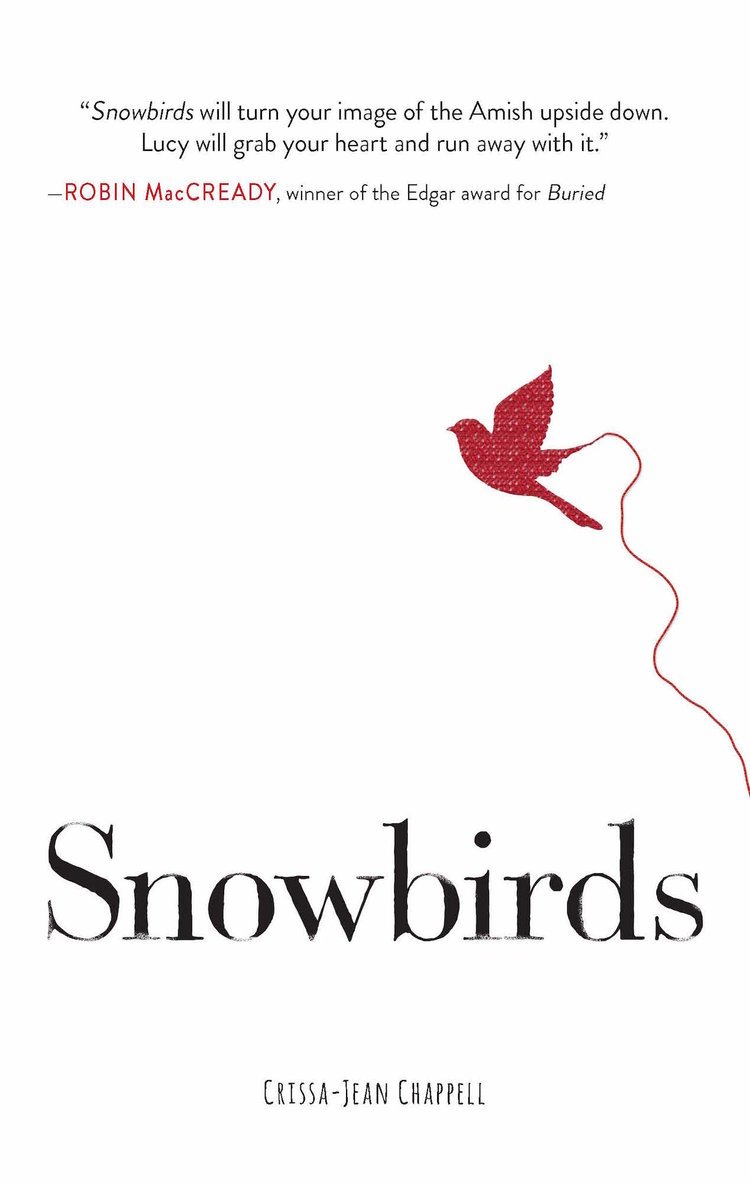
Book Review of Snowbirds by Crissa-Jean Chappell


When I was enrolled in a professional writing program in college, Amish fiction was trendy in publishing. Everywhere you looked, it seemed there was another murder mystery where the killer or the main witness was hiding out in Amish country, a forbidden romance featuring quilts and buggies, or a novel about the joys of a basic lifestyle far from the trappings of the Internet and the modern world. Our local newspaper even featured a column--part slice-of-life, part recipe--written by a local Amish woman who gave her English neighbors a peephole into her world. I couldn't have been less interested. Ditto, the tabloid-esque shows on TLC. I had a writing instructor who joked that, if you wanted to get published, you should write a novel about "the Amish."

But, the thing is... while Snowbirds by Crissa-Jean Chappell does take place within Amish (and Mennonite) communities (and also differentiates twixt the two, for those readers who may be confused and think they're the same thing), it isn't really about being Amish. It's simply about being a teenager in a world where adults make the rules, and they feel too restrictive. Which is, as most people know, simply put--being a teenager. So, upon realizing this was likely the case from the book's description, I checked it out from the library. Though I completely understand the symbolism and aesthetic choices behind the cover design, and I feel they are appropriate to the story, they really aren't my cup of tea.

Though it may not seem, from the outset of the book, like protagonist Lucy has much freedom, her best friend and longtime penpal Alice doesn't see it that way. While Lucy is part of a Mennonite community in Florida, Alice comes down from the north every winter with her more conservative Old Order Amish mother. Alice is jealous of the pastel-colored dresses Lucy gets to wear, while Lucy is jealous that Alice can participate in Rumspringa. Neither actually has many choices of self-determination, but each is determined to carve her own path for herself, community opinions and rules be damned. So, when hard-partying rebel Alice goes missing, Lucy risks everything to find her.

Chappell provides an accurate and compelling picture of both Old Order Amish and Mennonite life, and shows the contrasts beautifully. Snowbirds feels as if it was written respectfully, while still posing questions about what such societies can truly offer young women, and how such communities can evolve to become more functional, instead of simply good-looking on the surface. The mood--stubborn piousness, suspicion of outsiders, quickness to shun--is conveyed well, and is the cornerstone upon which Snowbirds sits.

One of the most interesting relationships is that of Lucy and her dad. It provides a stark contrast to the sad well of dysfunction that is relationship between Alice and her mom. Even though things between Lucy and her dad are far from perfect, he seems to want good things for his daughter, and to desire to protect her. Alice's mom merely appears to care about her own reputation within the community. 

Unfortunately, what could be a suspenseful plot--Lucy frantically investigating Alice's disappearance--is somehow turned into a slow, poetic amble, thanks to Chappell's snail-paced prose. Chappell puts a premium on flowery visual description, which frequently came at the price of holding my interest as a reader. At times, I felt like I was reading a bad parody of Walden, rather than a YA novel about a girl searching for her missing friend. 

If you like pretty descriptions of nature infused with occasional faith or teenage-angst-based intrigue, Snowbirds is for you. If you get bored with suspense novels that don't drive steadily forward or annoyed with novels that feel stark with not altogether satisfying endings, Snowbirds by Crissa-Jean Chappell is one to skip.

Friday, April 28, 2017

Book Review of The Garden of Small Beginnings by Abbi Waxman


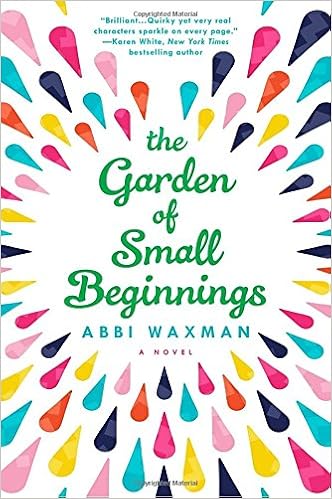
The Garden of Small Beginnings and I are in a Facebook Relationship, and our status is: It's Complicated. I'm still not sure exactly why I received this ARC in the mail. Did I enter a giveaway and then promptly forget having done so? Was it as a result of being on a list of book bloggers? I have no idea. Thus, it is a tad outside of my comfort zone, reading-wise. See, I enjoy some chick lit.. very selective chick lit. But the chick lit I enjoy is usually British, and runs to the likes of Jane Green and the lesser-known works of Sophie Kinsella, so as I unpacked and examined this book, I wondered if it was even close to my "thing." On the one hand, the cover is visually pleasing, colorful, and really lights up the pleasure buttons in the same parts of my brain that are obsessed with graphic design and typography, and is refreshingly devoid of a cartoonized couple kissing whilst surrounded by doodled hearts and flowers. On the other, I feared it would lean a bit too much toward the Eat, Pray, Love/Under the Tuscan Sun type of book for my taste. But, really: see what I mean about the cover?

Other than the cover, I love the way there are pages sandwiched between the chapters and each page features a sketch of a plant and then growing instructions for said plant, as if that page was pulled straight from a gardening manual. In addition to drawing me into the world of Lilian, a widow who has recently (against her will) become immersed in a community gardening class, rather effectively, these inserts also taught me some interesting and unforgettable facts about agriculture that provided a nice takeaway value, aside from the enjoyment the novel provided. I also really respected the way it would've been easy for Waxman to make Lilian's two young daughters simply cookie-cutter elementary school-aged girls, but instead, these characters are delightfully imbued with such distinctive personalities that I would've been able to tell their dialogue apart without attributions. The level of sarcasm and wit included in the dialogue and infused into the narrative voice really set The Garden of Small Beginnings apart from many other books of this type. In between banter about the gender identity of worms and the genitalia of whales, sappy kissing scenes just don't feel so cliche. And I like how Waxman doesn't simply gloss over Lilian's grief and loss, but truly forces her character to deal with it and illustrates just how bad it got by describing Lilian's resultant mental illness in pointed detail on several occasions.

However, there were weaknesses that particularly bothered me. Some were glaring continuity issues that distracted me from the story. Those charming between-chapter garden inserts felt as if they were written in the protagonist Lilian's voice (which is quite distinctive), but she is a professional illustrator and the book goes out of its way to say that she does not ever write any of the accompanying text for her illustrations (which have mostly appeared in textbooks up until this point), so that doesn't quite gel for me. Also, the instructor at the gardening class makes a point of saying how the participants will rotate from section to section of the community garden each week so that they can get the full range of experiences and learn how to grow all of the various plants... and then, the narrative has the characters show up and work in the same section of the garden on the exact same plants week after week for the entirety of the class. And very early in the book, Waxman makes a big deal of saying that Lilian frequently speaks aloud to her deceased husband--something which puts the reader on guard for exactly that... which, then, never happens in the manuscript. 

On the whole, Waxman's treatment of mental illness is hit-or-miss for me. I appreciated how she made it obvious that dealing with Depression wasn't simply something that could be checked off of a list, but something that required maintenance. But, I wondered if someone who'd had a similar experience and reaction to Lilian's regarding her husband's death might find some of the phrasing in the book offensive. Since that isn't me, however, I can't comment on it one way or the other. The chemistry between Lilian and her new potential love interest is compelling, and, since I actually don't enjoy much romance on the page, I appreciated that it was very subtle and more about communication (verbal and non-verbal, but also mostly non-physical), than it was about the physical aspect. I felt that Waxman's treatment of the dynamic heightened my interest, and I appreciated the subtlety.

All in all, whether or not I'd recommend The Garden of Small Beginnings to you depends completely on who you are and what you're looking for. If you're in it for a gardening-themed book, I'd say jump right in with no reservations. If you like to read about professional illustrators, there might be enough to keep you engaged. If you like witty banter and subtle flirtation, you'll probably love this book. If you are into hot-and-heavy romance novels, I'd give it a pass. But, if plot inconsistencies drive you crazy, this isn't the book for you. 

Thursday, April 27, 2017

Book Review of Windfall by Jennifer E. Smith

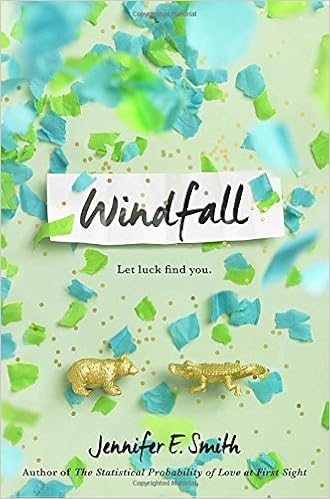
I enjoyed reading The Statistical Probability of Falling in Love, This Is What Happy Looks Like, and Hello, Goodbye, and Everything In Between, so when I found out I was going to receive a complimentary ARC of Windfall by Jennifer E. Smith through the First In Line VIP program, I may have squeed a little, and that's before I saw the cover design. This is one of my favorite covers of the year so far, because it is simple, visually pleasing, appropriate for the book, and highly meaningful. The concept is one that is compelling before you read it, but holds even more symbolism afterwards. ...and, did I mention it is just pretty? I kept flipping the book closed to look at it.

If you've read and loved books by Jennifer E. Smith before, this will be a must-read for you. If not, be prepared to appreciate the delicate balance Smith has achieved between light I-like-him-does-he-like-me teen romance and heavy life situation/big choices-centered drama. Somehow, neither fully takes over the book, and the story of Windfall is the result of that happy collision.

That said, I felt this story could've been told more effectively with some significant cuts. Weighing in at just over 400 pages, it began to feel long, and things lagged 1/2 to 2/3rds of the way through the book before picking up again near the denouement. I don't dislike long books--in fact, I love them, but only if the length adds to the story instead of taking away from it. I didn't need to read the same character's rationale for a decision or recounting of an incident more than once.

But there are still several strengths that outweigh Windfall's extra chapters. I enjoyed the fresh and nuanced parental characters. I appreciated that many of the characters were dynamic: especially when they were unexpectedly so. And chapter Forty-Nine, a mere three pages long, is one of the strongest, most compelling, most poetic pieces of prose I've ever read in YA. It left me wishing that the book had ended right there: on the highest note there was. 

All in all, I'd still recommend Windfall by Jennifer E. Smith, despite the extra length. And, if you're thinking of giving it as a gift, consider tucking a special bookmark inside--a Lottery ticket... one of the ones where you choose your own numbers. Windfall comes out May 2nd.

Wednesday, April 26, 2017

Book Review of The Illustrated Pirkei Avot: A Graphic Novel of Jewish Ethics by Jessica Tamar Deutsch

Image result for the illustrated pirkei avot jessica tamar deutschI don't think I could've been any more eager to review a book than when I found out someone had turned the Pirkei Avot into a graphic novel. I love graphic novels, and one of my favorite things to do as a Jew is study Jewish ethics, so I thought this would be a beautiful intersection of two of my strongest interests. I was a little less than thrilled when I saw that the illustration style was a bit hippie for my taste, but I figured it fit in with the "do unto your neighbor" message of the Pirkei Avot's teachings, so, bring on the Hamsas! That said, when the free copy I requested for the purposes of writing this review arrived, I couldn't have been more thrilled with the beautiful colors and metallic foil on the cover. Isn't it gorgeous? I couldn't wait to see how those amazing hues would look splayed across the pages of the text illustrating the Pirkei Avot!

Immediately, I encountered a huge disappointment: those eye-catching colors from the cover don't carry over onto the pages of the graphic novel, which are printed solely in black and white. In fact, this book is marketed as if it can also be a coloring book, as if that's a benefit, and not simply the result of a small press not making the investment to include pretty color printing to add visual interest to the body of work. Though I can see some people enjoying a coloring project such as this, I can also see that many readers will be extremely disappointed by the lack of color throughout the text, especially because it is called a graphic novel. (If it were called a coloring book, that would be a different story entirely.) Also, when charging $25 plus shipping for such a volume, I, and most other readers of graphic novels, tend to expect at least some color illustrations, especially when the book has only about 120 illustrated pages to begin with. And it was clearly not designed to be a coloring book: the pages are not perforated, the book does not lay flat, the thick, dark, black ink smudges when art markers are used to color in the white space, and the paper fibers shred when even the lightest pressure is applied from said art markers. So, $25 plus shipping is very expensive for a sub-standard coloring experience OR a sub-standard graphic novel reading experience.

However, I was still totally into the concept of the material within the book, and ready to get started refreshing my memory about some of the core tenets of Jewish ethics. After all, who can't use a refresher course? I was eager to see how Jessica Tamar Deutsch had managed to structure her book in such a way as to string together so many small nuggets of advice, wisdom, and teachings into a cohesive enough whole to make a graphic novel, instead of the format of the actual Pirkei Avot, which can be frustratingly disconnected and jolting as it moves from the teachings of one sage or Rabbi to the next, and topic to topic without transitions. Surely, someone from such an artistic background who was so free-thinking and creative and felt such a personal connection with the material had found a new way in and been able to break the teachings down into themed sections, or add a narrator to the text to guide the reader through it and parse the famous quotations for applicable meaning. Nope.

Deutsch's strength is her illustrations, which serve as the backbone of the work. If you love the style of her artwork, you'll treasure this book. If you find it grating on page 15, you'll be ready to tear your hair out by page 70, which features an elderly biker dude in a skull-decorated helmet growling angrily down the road on his hog past a cartoonized cactus. I just found it all distracting and annoying, instead of enlightening and enriching. I was hoping the illustrations would help me parse some of the more difficult-to-understand passages, but instead they were too hokey and trippy for me to take seriously, even when they were accompanying very serious teachings and text. For students of any age who find the original Pirkei Avot dry and difficult to engage with, and who enjoy this style of art, The Illustrated Pirkei Avot might provide a solution to that problem. The text is large, and boiled down to only the most sparse of necessary details.

My biggest complaint about this book is that Deutsch simply got some basic things wrong. I don't know if she (or her editor) didn't properly check the details, or cared more about the art than the text (which would be unfortunate, since it is being marketed as a religious teaching tool), but some of the quotations are incomplete, others are interpreted in bizarre ways, and still others are blatantly incorrect. Aside from my personal taste with regard to the artwork (which, I fully acknowledge is just that--my taste--and may not be shared by everyone), I cannot recommend this book for any purpose because it contains inaccurate teachings/translations/quotations.

Tuesday, April 25, 2017

Book Review of The Whole Thing Together by Ann Brashares

I was thrilled to receive a review copy of The Whole Thing Together by Ann Brashares from the publisher free for the purposes of this review because I loved the Traveling Pants books. I was also excited because I haven't exactly loved some of Brashares' later works, and I was ready to give her writing another chance. I found the premise of Whole Thing delightfully interesting: two teenagers, a guy and a girl, both the same age, whose parents used to be married to each other are now on the flip side of a historically acrimonious divorce. They've never met, but they alternate using the same bedroom in a beach house neither parent is willing to give up, and they share three older sisters. Everything from the partly beach house/partly urban setting to the sprawling-but-disjointed family peaked my curiosity. I don't particularly care for the cover, and, after reading the book, I can honestly say that it doesn't truly fit the story... nor do the people shown match up with some of the character descriptions or with the most important characters one would expect to appear on the cover. And, for some reason, it feels much more like a West Coast beach than an East Coast one to me.

What isn't apparent from the book's summary is that Brashares delves deeply into issues of class and income, adoption and biological families, and racial identity, and she does it all with a sense of grace and a feeling that this isn't an "issue book," but one where the characters and the story veered toward serious topics on their own. Thus, what could've been a breezy beach read or a throwaway book about a family feud has been elevated into a statement about what it really means to be a family, choosing your own identity, and what may get lost or found in the process.

The Whole Thing Together feels much more literary than Brashares' previous works. It also feels like an answer to the Sisterhood books, somehow, as if Brashares sought to write a reply to questions she asked in those volumes, but left without a response. Here, she spills out each can of worms artfully before packing them back up, instead of merely removing the lids and commenting on their presence, as she had previously. This deeper exploration of the cracks in the foundation--from nasty truths about judgments regarding class, income, and rarefied education to parentage and race--makes the characters and plot all the richer. What does it mean that the character (Robert) with the strongest Indian background in the book refuses to discuss it, acknowledge it, or embrace anything from his culture, has married two blonde-haired women, and favors the daughter who looks most her mother, his daughters want to know? Such profound and painful questions carry real weight throughout the book. 

I feel The Whole Thing Together is Brashares' strongest work to date, and definitely one to check out... especially if you're looking for a summer beach read that's more on the serious side, or a book to remind you that there are always families as messed up (or more messed up) than your own. Highly recommended, comes out today.